Computational Multiphase Physics
(CoMPhy)
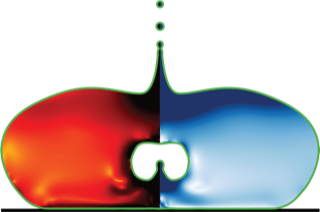
Welcome to the CoMPhy Lab’s documentation hub! We are based at the Physics of Fluids Department at the University of Twente, where we explore non-Newtonian free-surface flows and soft matter singularities.
About Us
See: About us
Published Notes and Documentation
Blog posts:
2025
Double Network Hydrogel:
2025-10-31 2025-Why-Double‑Network-Hydrogels-Dont-Shatter: Why double-network hydrogels combine stiffness and toughness without shattering - elastic screening mechanisms that prevent crack cascades by damping stress propagation between sacrificial bonds.
Scientist profiles & history:
2025-10-24 2025-Emmy-Noether-Symmetry-Conservation: Emmy Noether’s revolutionary contributions to mathematics and physics - from overcoming gender barriers in academia to discovering the profound connection between symmetry and conservation laws that now underpins all of modern physics.
Laser-droplet interactions:
2025-10-06 2025-Curvature-Inversion-in-Laser‑Struck-Droplets: Understanding how laser-induced pressure impulses control droplet sheet curvature in EUV lithography - from raised-cosine impulses to forward-bending sheets in tin microdroplets.
Computational tools & visualization:
2025-10-01 2025-visual-pdes: Interactive browser-based PDE simulator - exploring pattern formation, reaction-diffusion systems, and mathematical visualization through GPU-accelerated simulations. A “Desmos for PDEs” that runs in your browser.
Elastoinertial turbulence:
2025-02-24 2025-Arrowheads-in-elastoinertial-turbulence: Critical review of arrowhead structures in elastoinertial turbulence, examining their existence in 3D flows and experimental observations.
Drop impact dynamics:
2025-02-22 2025-JFM-viscous-drop-impact: Comprehensive study of viscosity’s role in drop impact forces, from raindrops to inkjet printing applications.
Capillary waves:
2025-01-11 2025-Features-of-capillary-waves-during-asymmetric-bubble-coalescence: Analysis of capillary wave dynamics during bubble coalescence, focusing on energy transfer and wave propagation mechanisms.
Code Documentation
2024
H-B formulation:
2024-12-31 2025-Herschel–Bulkley-formulation: Mathematical formulation of the Herschel-Bulkley model for non-Newtonian flows, with emphasis on yield stress fluids.
Lecture Notes:
Basilisk101
Basilisk101: Comprehensive course on computational fluid dynamics using the Basilisk C framework. Topics include:
- Conservation laws and numerical solutions of Navier-Stokes equations
- Transport equations and interface tracking methods
- Non-Newtonian flows and viscoelasticity
- Multi-phase flows and contact line dynamics
- Hands-on coding assignments with practical implementations
Introduction to Soft Matter
Intro-Soft-Matter: Graduate-level course exploring soft condensed matter physics. Course structure includes:
- Fundamental concepts: What makes materials “soft”?
- Viscosity and momentum diffusion from kinetic theory
- Soft matter instabilities and singularities
- Rheology and viscoelastic behavior
- Weekly lectures with self-assessed homework and student presentations
Individual Lecture Notes:
2025-11-05 4-Soft-Matter-Singularities: Lecture on finite-time singularities in soft matter, covering pinch-off, contact-line singularities, and scaling behavior across inertial, viscous, and viscoelastic regimes.
Talks:
2026
Seminar Presentations:
2026-01-07 Seminar-Coalescence-with-Surfactants: Seminar on asymmetric sessile-drop coalescence showing how insoluble surfactants can bias bridge growth, induce Marangoni-driven drift, and select merge-versus-non-merge outcomes.
2026-01-05 Seminar-Singularities: Seminar on hydrodynamic singularities in soft matter, connecting drop impact, bubble bursting, and retracting films through experiments, simulations, and theory.
Connect With Us
- 🌐 Website: comphy-lab.org
- 📧 Email: vatsalsy@comphy-lab.org
- 🐦 Twitter: @VatsalSanjay
- 💻 GitHub: github.com/VatsalSy
Contributing
We welcome contributions from researchers, students, and collaborators. Here’s how you can contribute:
-
Issues: Found a problem or have a suggestion? Choose an option below:
-
Pull Requests: Want to contribute directly?
- Fork the repository
- Make your changes (it can simply be correcting grammar or making a new post - simply write in plain text or markdown format and add it to the root folder).
- Submit a pull request with a clear description of your changes
Visit our GitHub repository to get started.
Note: This documentation is maintained by the CoMPhy Lab team and is regularly updated with our latest research findings and computational methods.
Back to main website