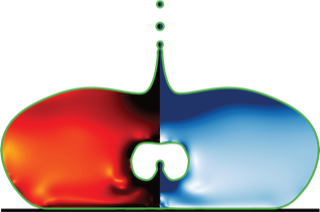
PDF version
TL;DR
An elastic solid resists deformation, a viscous liquid resists the rate of deformation, and a viscoelastic material does both; which response wins depends on how fast the material is deformed. Tiny amounts of dissolved polymer change how jets, filaments and films break into droplets, from inkjet printing to coughs and sneezes. To describe such flows we keep Cauchy’s momentum equation and add a polymer stress that depends on the conformation tensor
, which measures how stretched the polymers are. In the Oldroyd-B family of models the polymers are stretched by the flow and relax with a single relaxation time . Its limits are a viscous liquid ( ) and a Kelvin–Voigt solid ( ). The Kelvin–Voigt solid is elastic or purely dissipative depending on its retardation time (solvent viscosity divided by elastic modulus). In dimensionless form, three numbers span the parameter space: the Deborah number (material memory against flow time), the elastocapillary number (elastic against capillary stress) and the solvent Ohnesorge number (viscous against inertio-capillary effects). Both and give a Newtonian liquid.
0) Continuum mechanics across fields
The lecture opened with two images that show the same pattern. In the first, a bubble resting on the surface of a very viscous liquid is punctured at its apex. As the hole opens and the thin film collapses, the film develops a ring of radial wrinkles (Oratis, Bush, Stone & Bird 2020). In the second, a rod pushed into an inflated beach ball produces radial wrinkles in a ring around the rod (Vella, Ajdari, Vaziri & Boudaoud 2011). One material is a liquid and the other a solid, yet they wrinkle in the same way.
In both cases a thin sheet is compressed along the azimuthal direction, and a thin sheet would rather bend out of its plane than shorten within it. For the indented shell, Vella et al. showed that a single dimensionless tension sets the pattern,
For the viscous bubble, Oratis et al. tilted bubbles sideways and turned them upside down, and showed that gravity is not what drives the collapse: surface tension and the dynamic stress in the compressed liquid film drive both the collapse and the wrinkling.
Continuum mechanics treats both systems with the same momentum balance. Only the constitutive law changes, that is, the relation between stress and deformation. For slow flows, in which inertia is negligible, the governing equations correspond exactly. An incompressible Newtonian liquid, with stress
This lecture is about the materials in between, whose stress depends on both the deformation and its rate.
1) Why do we care?
1.1 Elastocapillary jets in inkjet printing
An inkjet printhead fires a drop trailed by a long, slender filament. Ideally the filament retracts into a single drop; if it breaks up instead, it leaves satellite droplets that degrade the print and contaminate the printer. Sen et al. (2021) showed that a minute amount of polymer can prevent this. Aqueous solutions of polyethylene oxide (PEO) at concentrations of about
“Elastocapillary” means that elastic and capillary stresses compete. The elastocapillary number
1.2 Mist: how sneezes make droplets
Coughs and sneezes are turbulent, multiphase flows that can carry pathogen-bearing droplets of mucosalivary fluid, and how far the contamination reaches is largely set by droplet size. High-speed imaging at the mouths of healthy subjects (Scharfman, Techet, Bush & Bourouiba 2016) showed that the fluid keeps breaking up after it has left the mouth, through a cascade from sheets to bursting bags to ligaments and finally to droplets. The viscoelasticity of the mucosalivary fluid delays this fragmentation: droplet precursors that form along stretched filaments merge, which changes the drop-size distribution further downstream.
1.3 Where do the droplets come from?
Wei & Li (2016) summarise three places where respiratory droplets form (their figure 1):
- The upper airways (larynx and trachea). Fast airflow destabilises the liquid that lines the airway wall and tears droplets from it.
- The oral cavity. Saliva in the mouth is atomised by the outgoing air.
- The bronchioles. Liquid films close the smallest airways during exhalation and rupture when the airways reopen during inhalation.
These sites go with three proposed droplet-size modes: a bronchiolar film-burst mode during normal breathing (diameters up to about
1.4 Coughing as mimicked in the lab
A “cough machine” reproduces the first of these mechanisms (Kant, Pairetti, Saade, Popinet, Zaleski & Lohse 2023). A horizontal channel,
Li, Saade, Zaleski, Sen, Kant & Lohse (2025) replaced the Newtonian film with mucosalivary-mimetic PEO solutions. The viscoelastic films still fragment through bags, but the bags inflate further, so their sheets are thinner before they rupture (and, in the simulations, more uniform), and the droplets are smaller. Their simulations use the Oldroyd-B model that we build in §3.
The lecture contrasted two routes from liquid to droplets: jetting, in which liquid is drawn into a jet or filament that then breaks up (the inkjet filaments of §1.1, or the Worthington jets of Lecture 6), and bag-mediated atomisation of a sheared film, as here. In every example a thin film or filament is stretched and thinned, and its fate depends on whether the liquid resists viscously, elastically or both. To say more we need a constitutive model.
2) How do we model polymeric flows?
2.1 Momentum balance
We keep the Cauchy momentum equation,
with
2.2 Splitting the stress
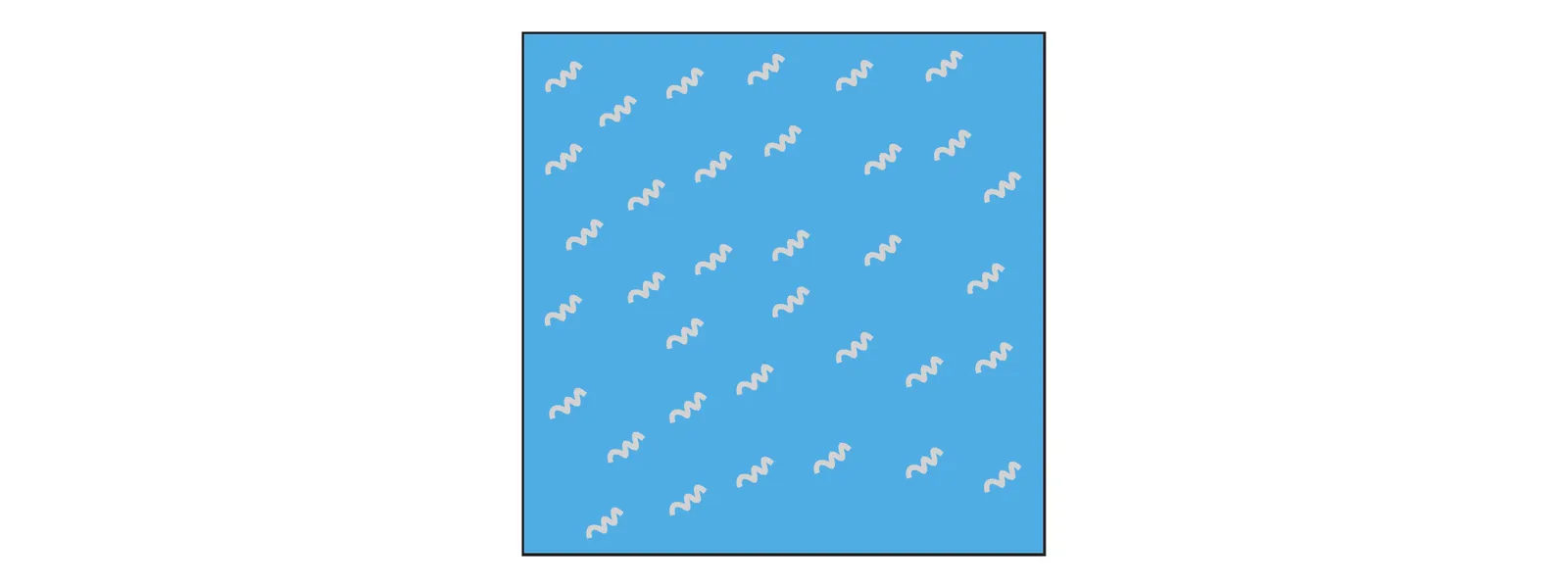 A dilute polymer solution: flexible polymer coils (grey) dispersed in a Newtonian solvent (blue). The solvent contributes a viscous stress; the coils contribute a stress that depends on how stretched they are.
For a dilute polymer solution we write
The pressure
for the extra stress, the part of the stress that is not pressure. The diagrams in this lecture write this extra stress as
2.3 The conformation tensor: an order parameter for polymer stretch
In the simplest microscopic picture each polymer coil is a dumbbell: two beads joined by an entropic spring, with end-to-end vector
At rest the coils are isotropic,
For linear (Hookean) entropic springs the polymer stress is linear in
where
3) The Oldroyd-B family of models
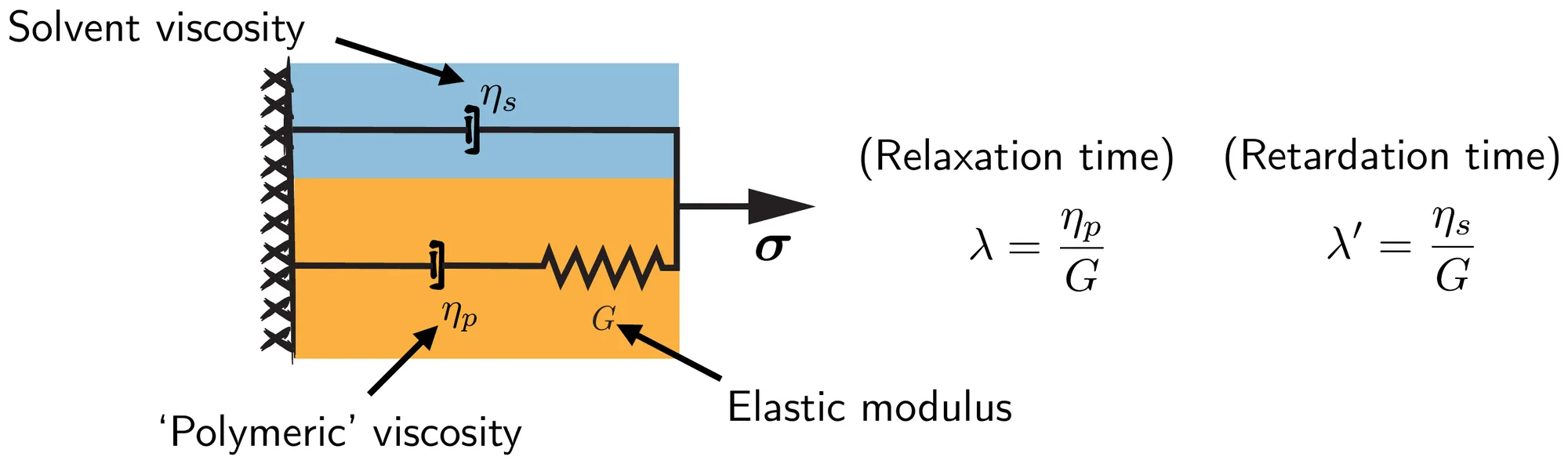 Mechanical analogue of the Oldroyd-B model. The solvent (blue) acts as a dashpot of viscosity
The Oldroyd-B model completes the description with an evolution equation for
The mechanical analogue has two time scales,
so the polymer viscosity is
with
Why this derivative? If the polymers were simply carried by the flow, each end-to-end vector would deform like a material line element,
In steady simple shear the Oldroyd-B viscosity is
Which retardation time?
The lecture defines
, the retardation time of the Kelvin–Voigt limit (§4). For finite , eliminating shows that the total extra stress obeys This
is the usual textbook retardation time of the Oldroyd-B model. It reduces to when , which is the limit in which matters below.
4) The limits of the Oldroyd-B family
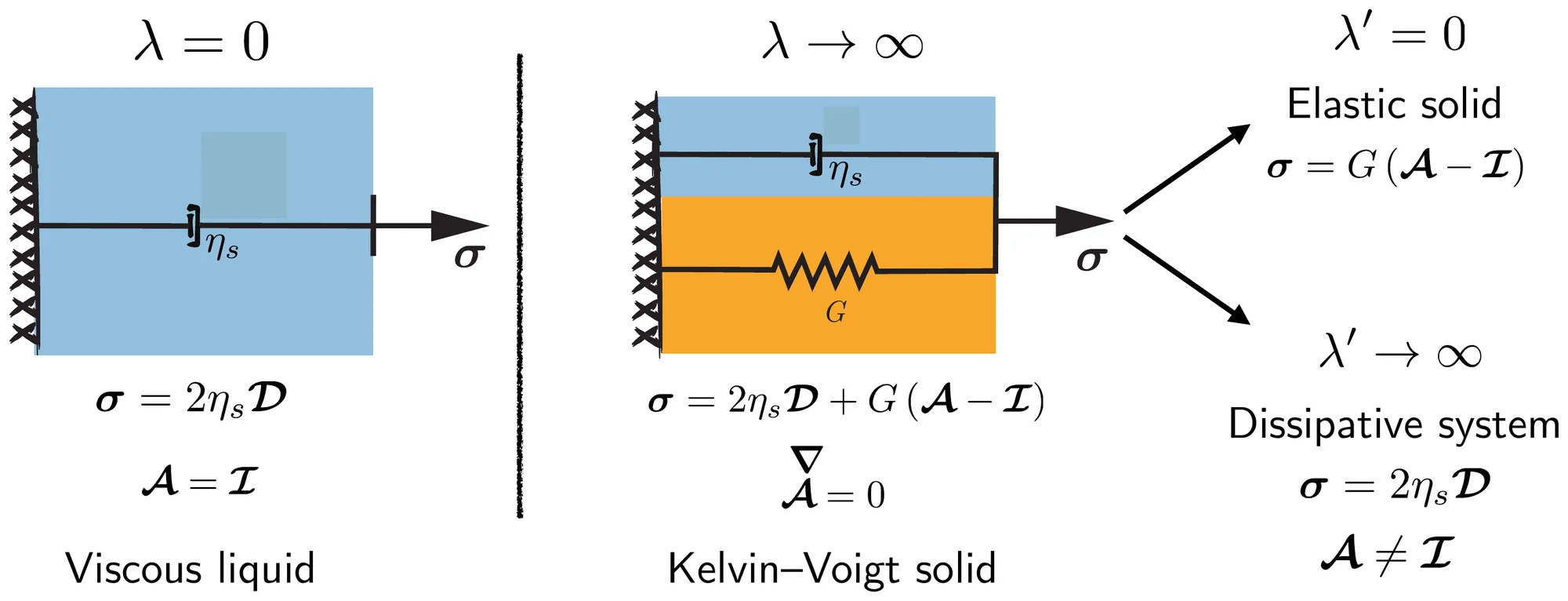 The limits of the Oldroyd-B family. Left:
4.1
At fixed
For small but finite
4.2
Now
where the deformation gradient
which is a Kelvin–Voigt solid. Which of the two parallel branches dominates depends on the retardation time
( ): elastic solid, . Solvent damping is negligible. ( ): dissipative system, . The polymers are deformed and keeps recording the deformation, but on this time scale the stress they carry is negligible compared with the viscous stress, and the response looks purely viscous. of order one: a genuinely viscoelastic solid.
Not every viscoelastic material flows
For any finite
the Oldroyd-B material is a viscoelastic liquid: under a constant stress it eventually flows steadily with viscosity (§5.1). The Kelvin–Voigt limit is a viscoelastic solid: under a constant stress its shear strain saturates at , and it recovers completely when the stress is removed. A time-dependent response does not by itself mean that a material flows at long times.
5) Viscosity + elasticity = viscoelasticity
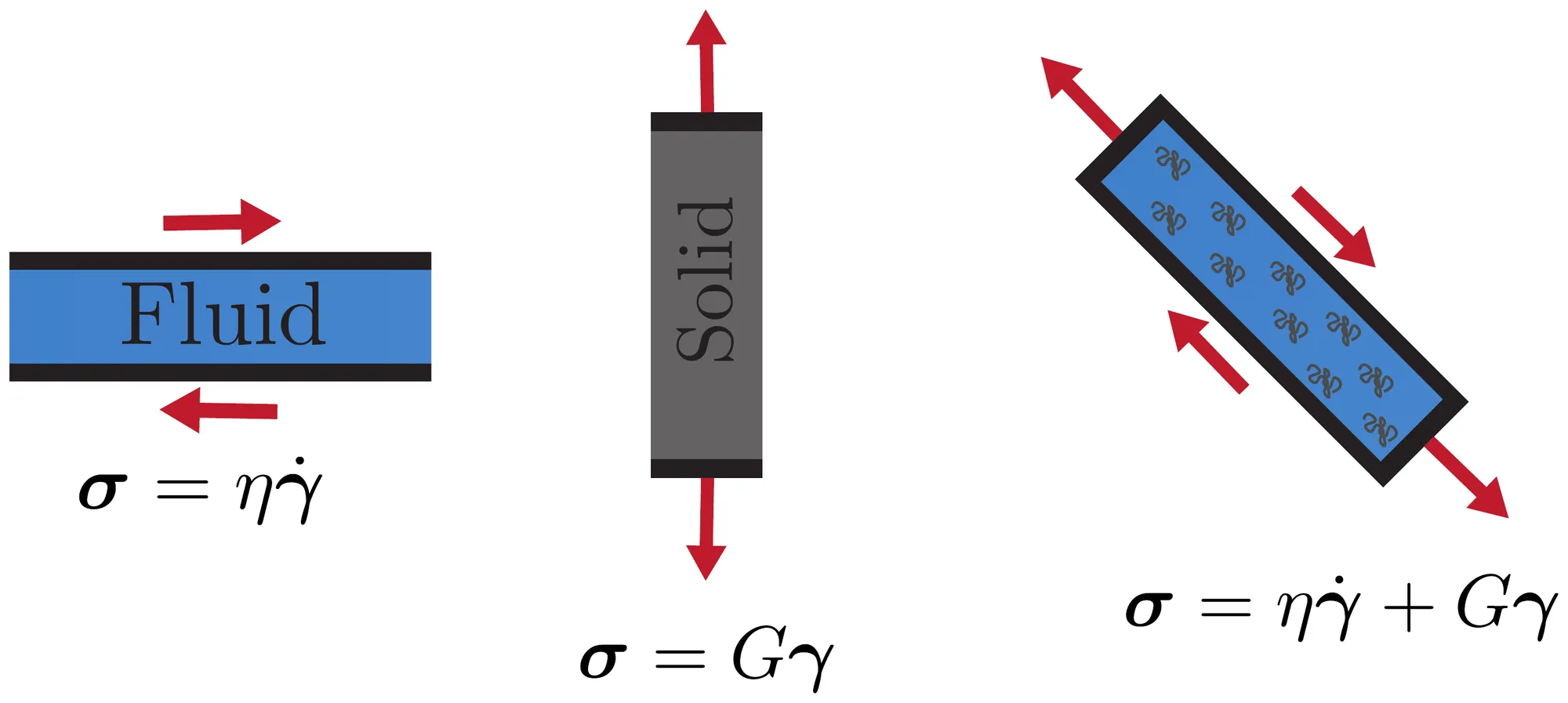 Viscosity + elasticity = viscoelasticity. A fluid resists the rate of deformation, a solid resists the deformation itself, and a viscoelastic material does both. The
Strip the model down to one dimension. In simple shear, with shear stress
- Fluid:
(Newton). Stress is proportional to the rate of deformation, and the work done is dissipated. - Solid:
(Hooke, in shear). Stress is proportional to the deformation, and the work done is stored. - Viscoelastic:
.
The cartoon draws the solid being stretched rather than sheared. For uniaxial stretching of an incompressible material the corresponding coefficients are Young’s modulus
The combined law is exactly the Kelvin–Voigt limit of §4, with
This holds at any strain, not only small ones: the neo-Hookean shear stress is linear in
5.1 Two ways to combine a spring and a dashpot
Kelvin–Voigt (parallel),
There is no instantaneous jump in strain, because the dashpot cannot move in zero time. The strain creeps towards
Maxwell (series),
Under a constant stress
Oldroyd-B (solvent dashpot in parallel with a Maxwell element). Linearised in simple shear, the model gives
Creep of the full model
Under a constant stress
applied to relaxed polymers at , the linearised model gives At first the polymers are unstretched and only the solvent resists, so the material starts to shear at the rate
. At long times it flows steadily with viscosity : a viscoelastic liquid. As this becomes the Maxwell response; as at fixed and , it becomes the Kelvin–Voigt response with .
5.2 The time scale decides
The comparison that runs through this lecture is between the relaxation time
6) Parameter space
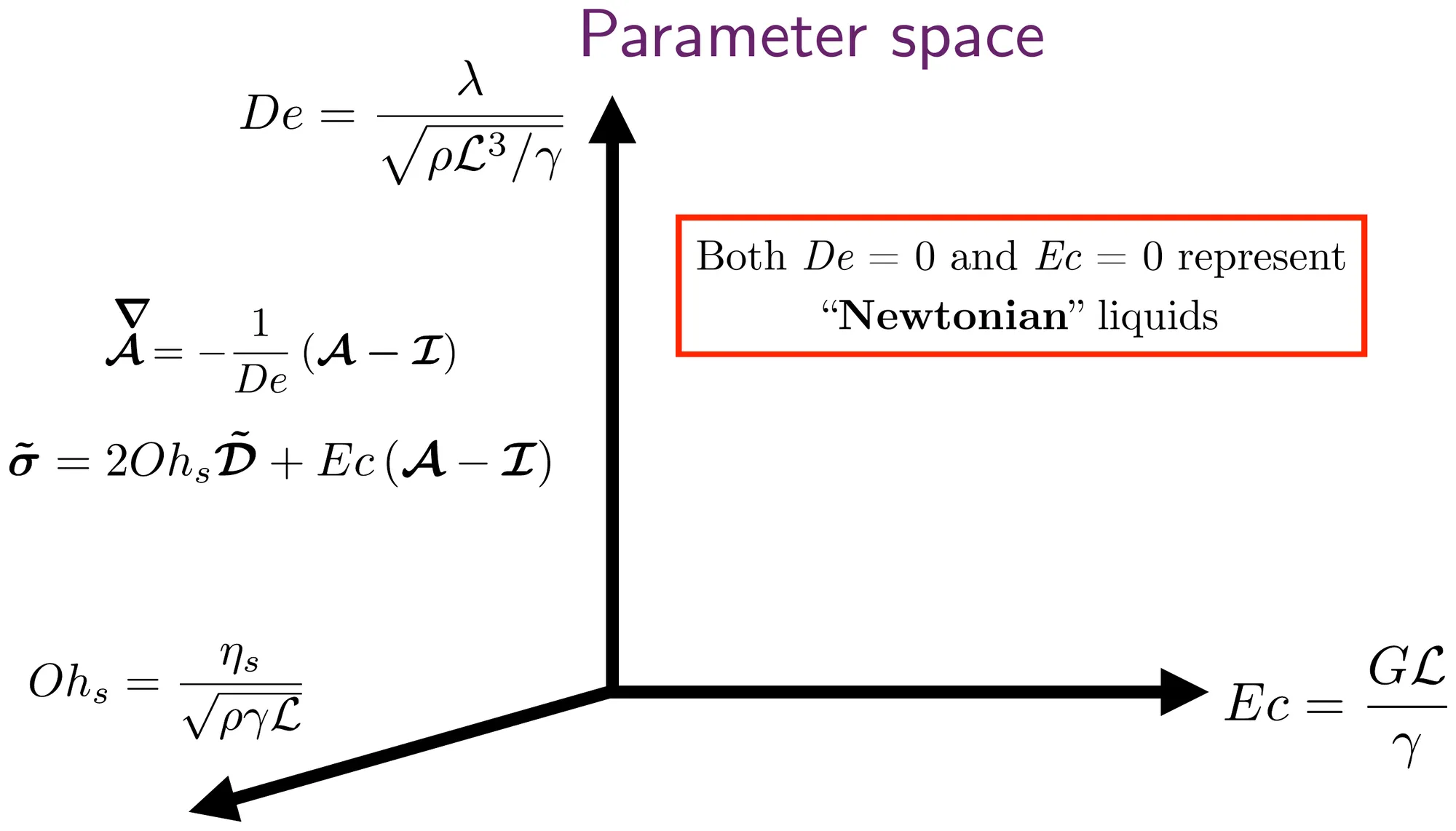 The parameter space of the dimensionless Oldroyd-B model. The
For the free-surface flows of Lecture 6, take a length scale
The Deborah number
where
Two combinations recur:
The polymeric Ohnesorge number
: viscous liquid. At small with finite, the liquid is Newtonian with total Ohnesorge number . : Kelvin–Voigt solid. It is elastic when and dissipative when . : the polymer stress vanishes whatever is, leaving a Newtonian liquid with viscosity . At large this is the dissipative limit of §4 seen from the other side, since .
Two routes to a Newtonian liquid
Both
and represent Newtonian liquids, for different reasons. At the polymers relax before the flow can stretch them ( ). At the flow may stretch them ( ), but they carry no stress.
Two cautions. First,
Summary
- Viscous and elastic sheets obey the same momentum balance and can show the same patterns; only the constitutive law differs, and for slow flows the two are mathematically equivalent.
- Small amounts of polymer change how liquids fragment: they suppress satellite droplets in inkjet printing, delay the breakup of sneeze ejecta and make thinner bags and smaller droplets in a cough machine.
- Polymeric flows are modelled by adding a polymer stress
to the Newtonian stress, where the conformation tensor ( at rest) measures polymer stretch. In the Oldroyd-B model it obeys , with and retardation time . - Limits:
gives a viscous liquid; gives a Kelvin–Voigt solid, which is an elastic solid for and a purely dissipative system for . For finite the material is a viscoelastic liquid; the Kelvin–Voigt solid is a viscoelastic solid. - In one dimension,
is the Kelvin–Voigt solid. It creeps to without an initial jump, whereas a Maxwell element relaxes stress and flows. - In dimensionless form,
, and span the parameter space, with and . Both and give Newtonian liquids.
Self-check questions
- Show that
and are equivalent. Which conservation law do you need? - Show that if every end-to-end vector deforms like a material line element,
, then . Use to show that in the limit . - Expand the Oldroyd-B equation for small
to show that , and hence that the polymers add a viscosity . - In the Kelvin–Voigt limit, find all components of
for a simple shear of amount , and show that the first normal stress difference is . What does the scalar law miss? - For finite
in steady simple shear at rate , show that and , that the shear viscosity is , and that . Does the Oldroyd-B liquid shear-thin? - A constant stress
is applied for and then removed. Sketch for a Maxwell element and for a Kelvin–Voigt solid. Which one shows an instantaneous strain jump, and which one recovers completely? - For a
wt% PEO solution, Li et al. (2025) report ms, a plateau viscosity of mPa·s (against mPa·s for the solvent), kg/m³ and mN/m, for films of thickness mm. Assuming an Oldroyd-B liquid with mPa·s and mm, estimate , , , , and . Then show that in uniaxial extension at rate , grows exponentially when . Why might the polymers matter in a thinning bag even though ?
References
- A. T. Oratis, J. W. M. Bush, H. A. Stone & J. C. Bird, A new wrinkle on liquid sheets: Turning the mechanism of viscous bubble collapse upside down, Science 369, 685–688 (2020). doi:10.1126/science.aba0593
- D. Vella, A. Ajdari, A. Vaziri & A. Boudaoud, Wrinkling of pressurized elastic shells, Phys. Rev. Lett. 107, 174301 (2011). doi:10.1103/PhysRevLett.107.174301
- M. Gomez, D. E. Moulton & D. Vella, The shallow shell approach to Pogorelov’s problem and the breakdown of ‘mirror buckling’, Proc. R. Soc. A 472, 20150732 (2016). doi:10.1098/rspa.2015.0732
- U. Sen, C. Datt, T. Segers, H. Wijshoff, J. H. Snoeijer, M. Versluis & D. Lohse, The retraction of jetted slender viscoelastic liquid filaments, J. Fluid Mech. 929, A25 (2021). doi:10.1017/jfm.2021.855
- B. E. Scharfman, A. H. Techet, J. W. M. Bush & L. Bourouiba, Visualization of sneeze ejecta: steps of fluid fragmentation leading to respiratory droplets, Exp. Fluids 57, 24 (2016). doi:10.1007/s00348-015-2078-4
- J. Wei & Y. Li, Airborne spread of infectious agents in the indoor environment, Am. J. Infect. Control 44, S102–S108 (2016). doi:10.1016/j.ajic.2016.06.003
- P. Kant, C. Pairetti, Y. Saade, S. Popinet, S. Zaleski & D. Lohse, Bag-mediated film atomization in a cough machine, Phys. Rev. Fluids 8, 074802 (2023). doi:10.1103/PhysRevFluids.8.074802
- M. Li, Y. Saade, S. Zaleski, U. Sen, P. Kant & D. Lohse, Viscoelasticity reduces the droplet size in mucosalivary film fragmentation during intense respiratory events, Phys. Rev. Fluids 10, 084001 (2025). doi:10.1103/zlgy-36dk; preprint arXiv:2502.05105
- J. G. Oldroyd, On the formulation of rheological equations of state, Proc. R. Soc. Lond. A 200, 523–541 (1950). doi:10.1098/rspa.1950.0035
- J. H. Snoeijer, A. Pandey, M. A. Herrada & J. Eggers, The relationship between viscoelasticity and elasticity, Proc. R. Soc. A 476, 20200419 (2020). doi:10.1098/rspa.2020.0419
- M. Reiner, The Deborah number, Phys. Today 17, 62 (1964). doi:10.1063/1.3051374
- A. Morozov & S. E. Spagnolie, Introduction to complex fluids, in Complex Fluids in Biological Systems, ed. S. E. Spagnolie, pp. 3–52 (Springer, New York, 2015). doi:10.1007/978-1-4939-2065-5_1 (further reading)
Previous Lecture: Lecture 4: Soft Matter Singularities
Next Lecture: Lecture 6: Sheets, Bubbles and Drops
Course Home: Course Overview
Metadata
Author:: Vatsal Sanjay
Date published:: Jul 19, 2026
Date modified:: Oct 16, 2026
Back to main website