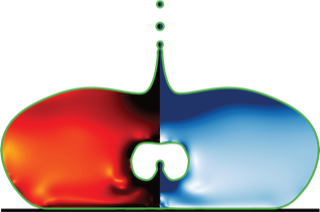
PDF version
TL;DR
Lecture 5 gave us one constitutive model, the Oldroyd-B family, whose limits are a viscous liquid, an elastic solid and a Kelvin–Voigt solid. This lecture puts it to work on three free-surface flows from current research: a retracting liquid sheet, a bursting bubble and an impacting drop. We compare material memory and stiffness through the Deborah number
(how long the material remembers its deformation, compared with how fast the flow is) and the elastocapillary number (how stiff the material is, compared with surface tension), while the solvent Ohnesorge number measures viscous effects. Drop impact adds the Weber number , which compares the incoming inertia with surface tension. The recurring question is which stress wins: capillary, viscous or elastic.
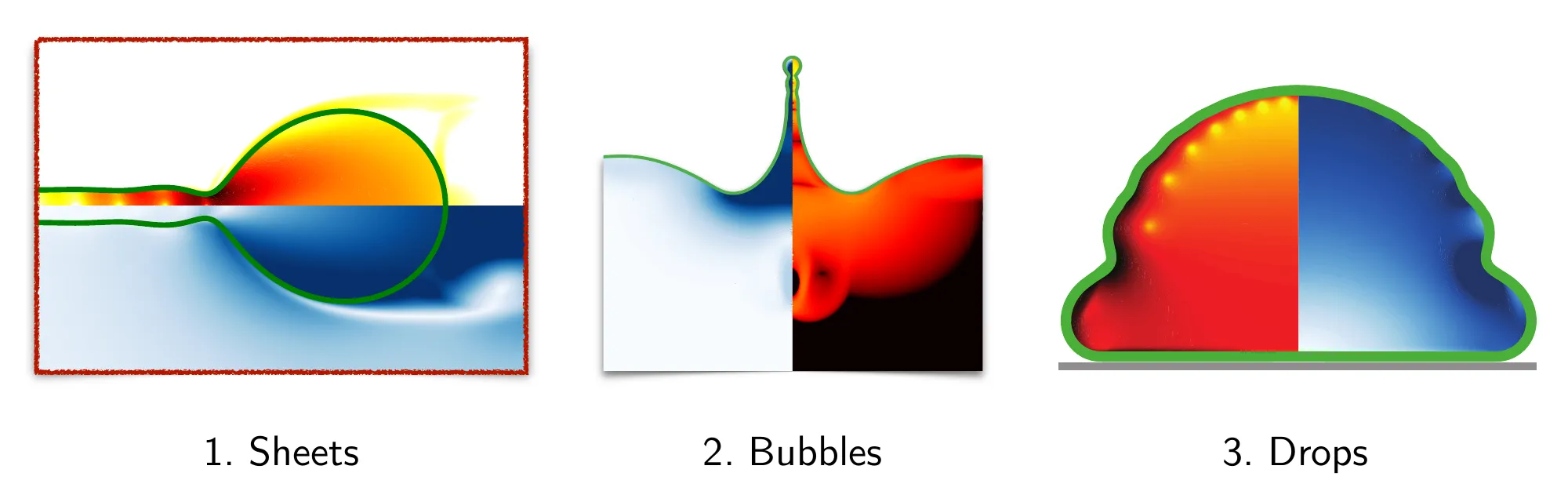 The three examples of this lecture, from direct numerical simulations: a liquid sheet retracting into a rim, a bursting bubble launching a Worthington jet, and a drop spreading on a surface.
0) Recap: one model, three limits
In a dilute polymer solution the stress has a solvent part and a polymer part:
Here
with
The limits of the model taught in Lecture 5 are:
: the polymers relax instantly, , and the material is a viscous (Newtonian) liquid. Keeping the first correction, , so the polymers simply add a viscosity . We use this in §2. : the polymers never relax, , and just records the deformation. Starting from a relaxed reference state ( ), , where is the deformation gradient. The polymer stress is then that of an elastic solid, in parallel with the solvent’s viscous stress: a Kelvin–Voigt solid. Over a deformation time , solvent damping is negligible when , and the response is then purely elastic.
Dimensionless groups
Take a length scale
and, writing
The Deborah number
Two routes to a Newtonian liquid
Both
and give a Newtonian liquid, for different reasons. At the polymers relax before they can be stretched ( ). At the polymers can be stretched as much as you like, but they carry no stress.
1) Sheets: retracting films
1.1 The Newtonian case
A punctured soap film retracts into a growing rim (see the high-speed video of a popped soap bubble). As we saw in Lecture 1.5, the rim moves at the Taylor–Culick speed
with
Simulations make the energy budget visible. Of the surface energy released,
The dissipation is concentrated in the neck where the film joins the rim, and its rate does not depend on the viscosity. Even as
1.2 What if the film is viscoelastic?
The “Friday afternoon experiment” in Lecture 1 showed that a polymeric film ruptures differently depending on how quickly it is blown (Tammaro et al. 2018): the timescale of the process matters. To isolate the role of elasticity, take the limit
What resists the opening? Picture a circular hole of radius
- Vertically, as the rim thickens (normal stress
). - Azimuthally, because each material ring is carried from its original radius
out to a larger radius . This is a hoop stretch , and it produces a tensile hoop stress .
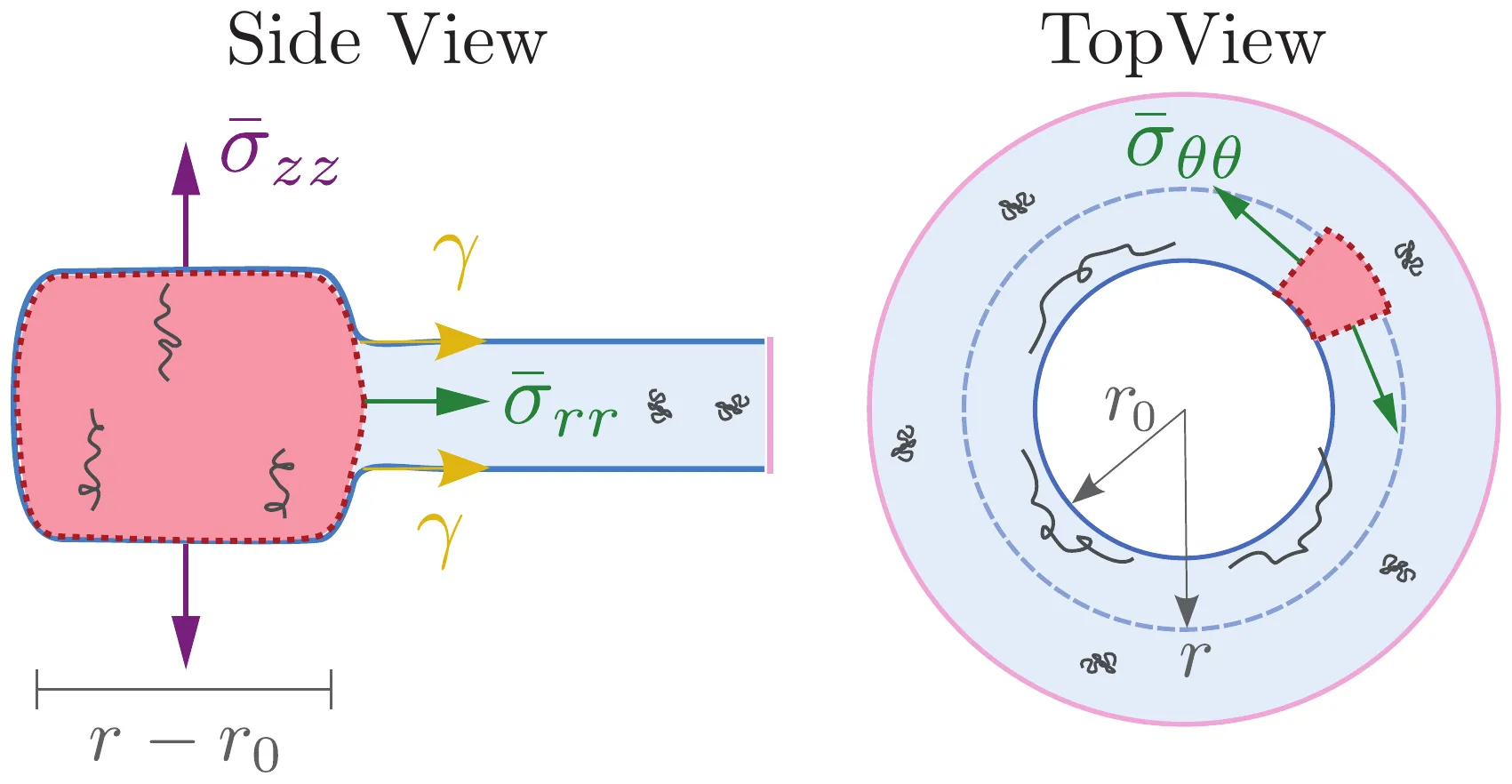 Stretching in the rim of an opening hole. Side view: the rim thickens, stretching the polymers vertically. Top view: material carried outwards from its original radius is stretched around the hole. Overbars denote thickness-averaged stresses, and
Only the hoop stress acts on the radial motion of the rim. With
The left-hand side is the rate of change of the rim’s momentum (its mass
To evaluate
The hoop stretch is largest for the material that has travelled furthest, which sits next to the rim. The hoop tension is therefore concentrated near the tip and grows as the hole opens. Comparing the modulus
We can go one step further. Suppose all the swept-up material sits in a thin rim at
To leading order, the ratio of this elastic resistance to the capillary pull
1.3 What the simulations show
Our direct numerical simulations (not yet published) solve the elastic limit
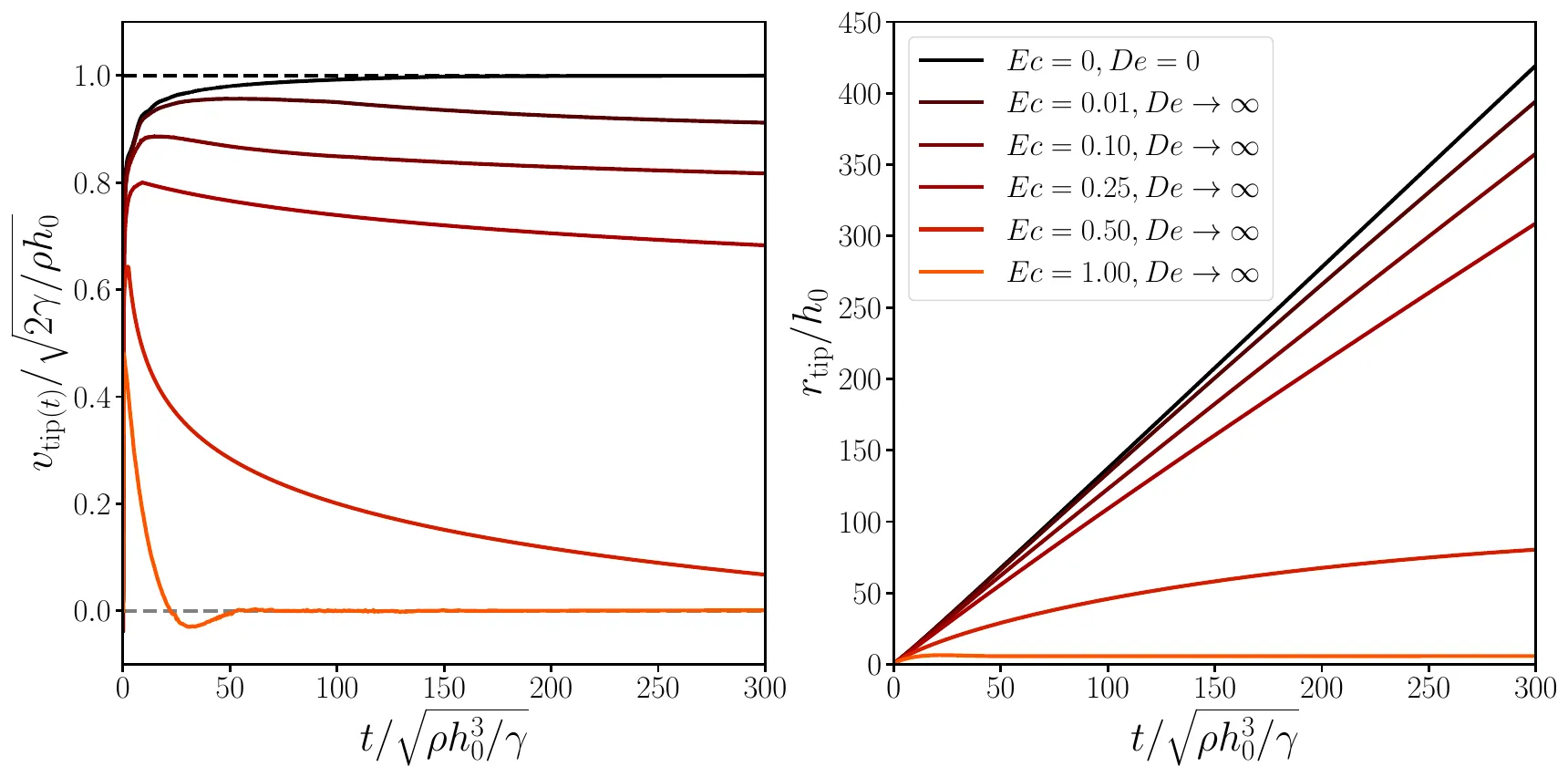 Opening of a hole in an elastic sheet. Left: tip speed
- Newtonian sheet (
): the rim reaches the Taylor–Culick speed, and the hole grows linearly in time. - Soft sheets (
): the rim never reaches and then slows gradually; at it moves at about , and for , and . - Stiffer sheets: at
the rim has almost stopped by . At it overshoots, recoils slightly and stops within about , at .
This is the trend of the hoop-force estimate: stiffer sheets stop sooner, and softer sheets keep slowing down.
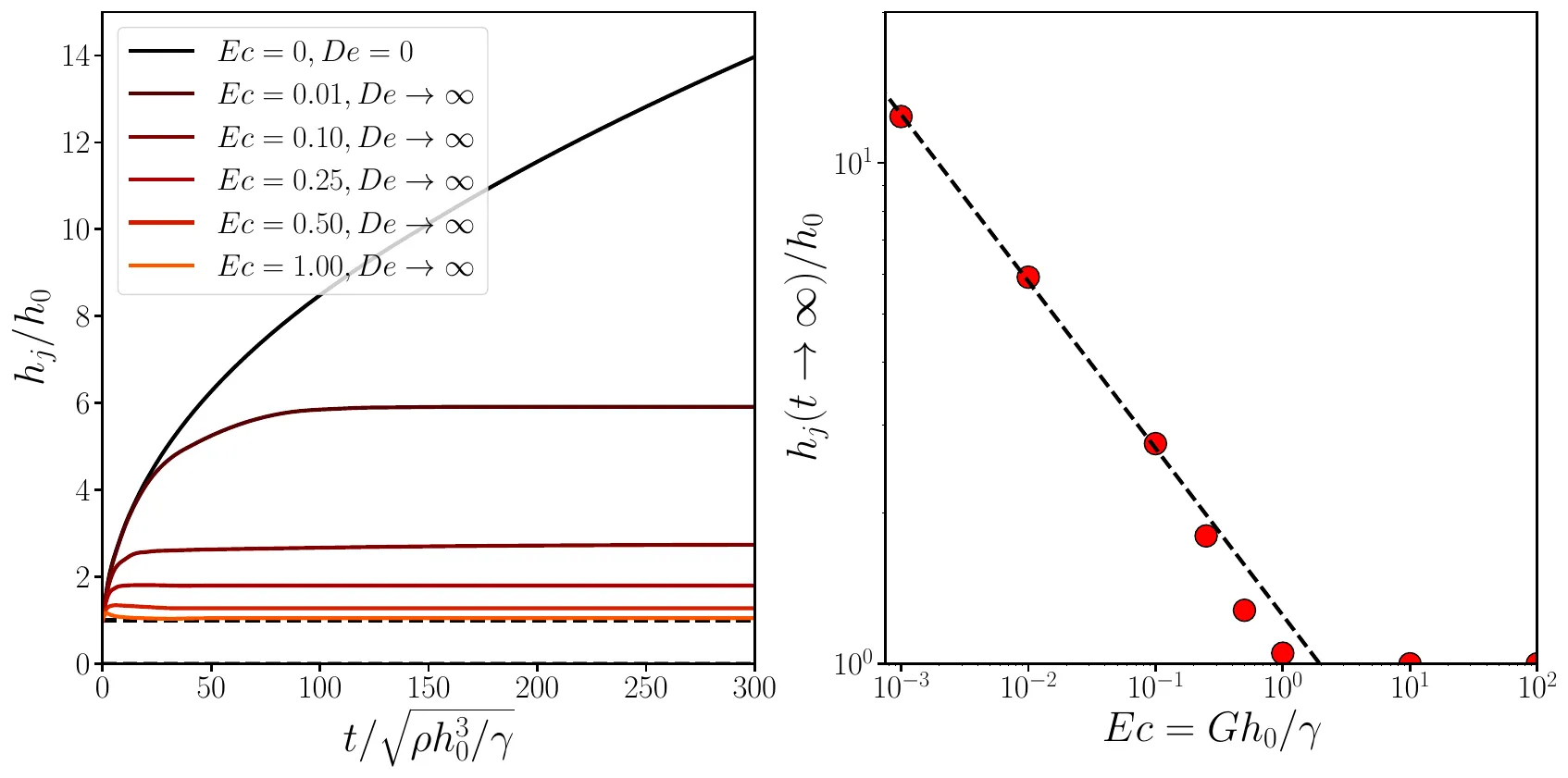 Rim thickness
The rim thickness tells a second story. A Newtonian rim keeps collecting liquid and thickening (
which the simulations follow for
The stress fields show where these forces come from. In the figures below (
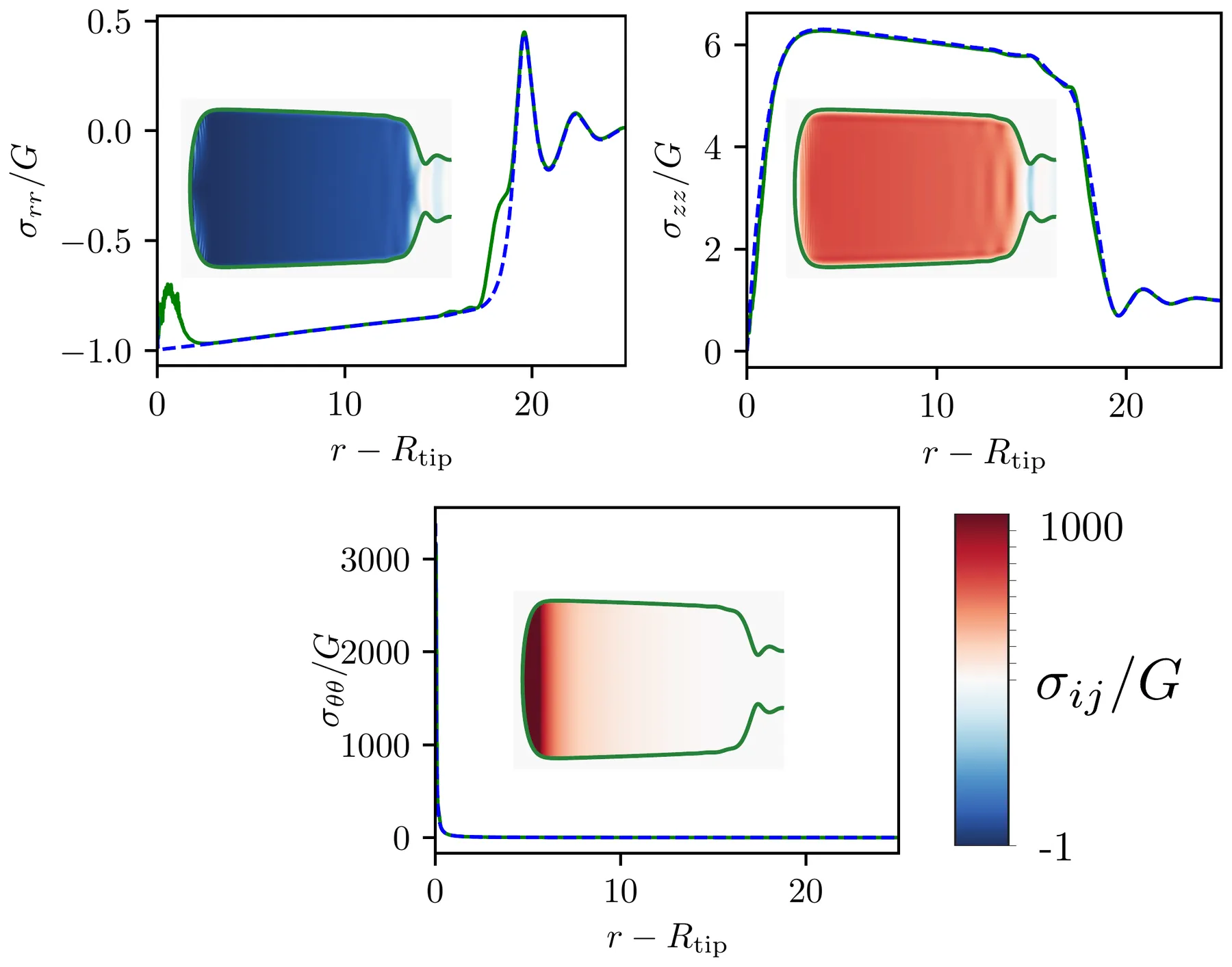 Radial (
- Vertical stress. Inside the rim
. The rim is then about thick, and a vertical stretch of gives : this is the stress that stops the rim from thickening further. - Radial stress. Inside the rim
. Material stretched vertically and around the hole is squeezed radially, so and . - Hoop stress.
is concentrated at the very tip, where the material has travelled furthest.
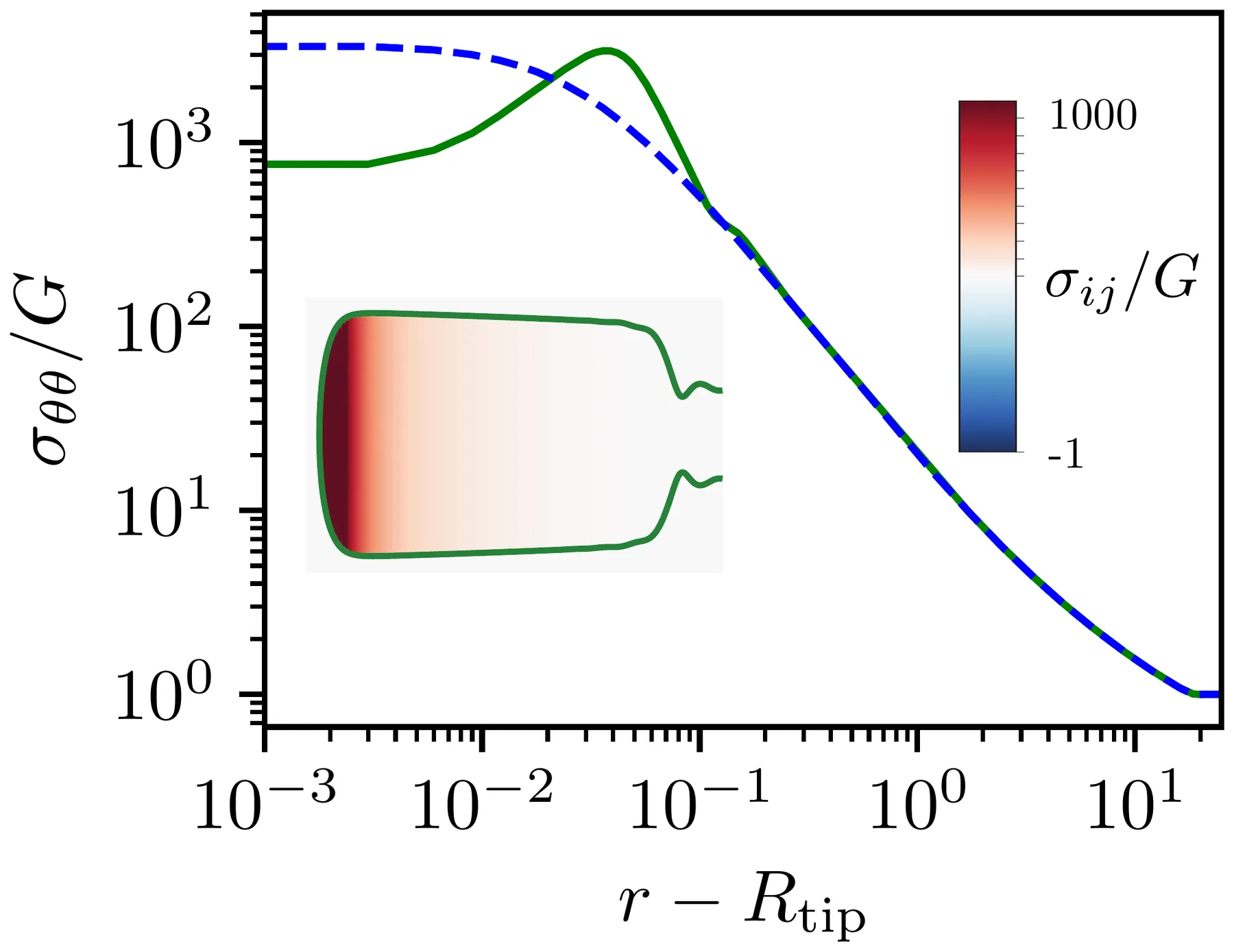 The hoop stress of the previous figure on logarithmic axes. Solid: simulation; dashed: elastic-mapping prediction.
On logarithmic axes the hoop stress falls by more than three decades over the plotted range. The prediction follows the simulation everywhere except within about
2) Bubbles: Worthington jets in viscoelastic liquids
2.1 Champagne and Worthington jets
A bubble that reaches a free surface bursts. After its cap ruptures, the open cavity collapses and capillary waves converge towards its base. Depending on the bubble size and the liquid properties, this focusing can produce an upward Worthington jet that breaks into droplets. In a glass of champagne these droplets carry the aroma above the glass (Ghabache, Liger-Belair, Antkowiak & Séon 2016). The same process launches aerosol droplets from the sea and from contaminated liquids. So what does a small amount of dissolved polymer do to the jet and its droplets?
The question is not new. Cheny & Walters (1996) compared the Worthington jets that rise after an impact on a liquid pool. For a Newtonian liquid the jet reached about 20 cm; for a Boger fluid (a dilute, elastic polymer solution of nearly constant viscosity) under the same conditions it reached only about 2 cm. They noted: “There is clearly much food for thought here, not least for those who attempt to simulate theoretically the flow behaviour of dilute polymer solutions.”
2.2 To jet or not to jet
Direct numerical simulations of bursting bubbles in an Oldroyd-B liquid (Dixit, Oratis, Zinelis, Lohse & Sanjay 2025) map out when a jet forms. Here
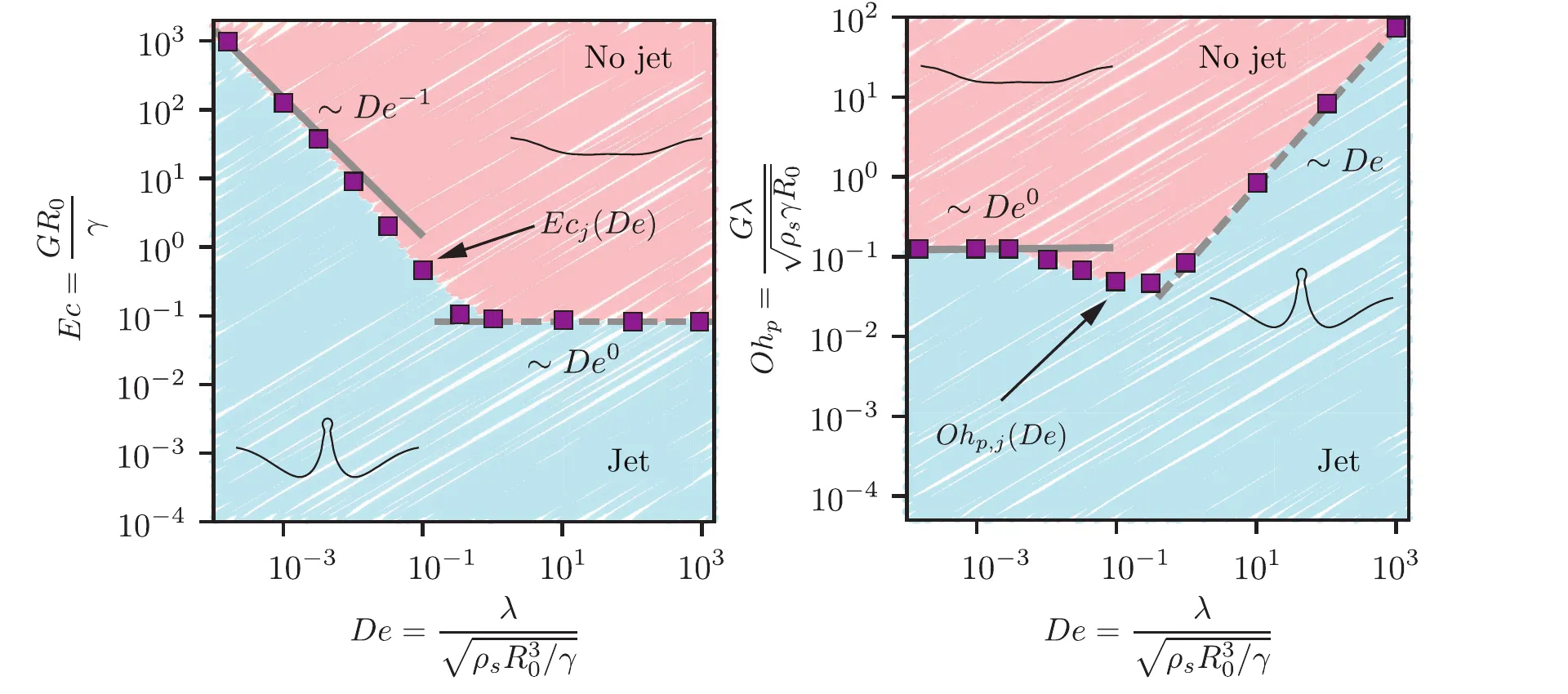 Jet versus no jet for a bursting bubble in a viscoelastic liquid. Left: in the plane of the Deborah number
The two panels show the same boundary, because
Read the map in two halves. The thresholds below describe the limiting branches of this parameter cut; their values are approximate, not universal.
- Small
(fast relaxation). The polymers relax faster than the cavity collapses, so they act only as extra viscosity . The jet disappears once the polymeric Ohnesorge number exceeds about , that is , which in the – plane is the line . - Large
(slow relaxation). The polymers keep their stretch during the collapse and act elastically. Now the elastic stress itself must be small enough: the jet disappears for above about ( ), which in the other panel is .
Within the jet regime the paper also separates jets that release droplets from jets that do not; for some intermediate values of
2.3 Why the polymers act as viscosity at small
A slender jet obeys a one-dimensional momentum balance (Shi, Brenner & Nagel 1994; Driessen, Jeurissen, Wijshoff, Toschi & Lohse 2013). For the axial velocity
with
Integrating over the jet, the momentum
Balancing the jet’s momentum flux against this stress gives
A constant
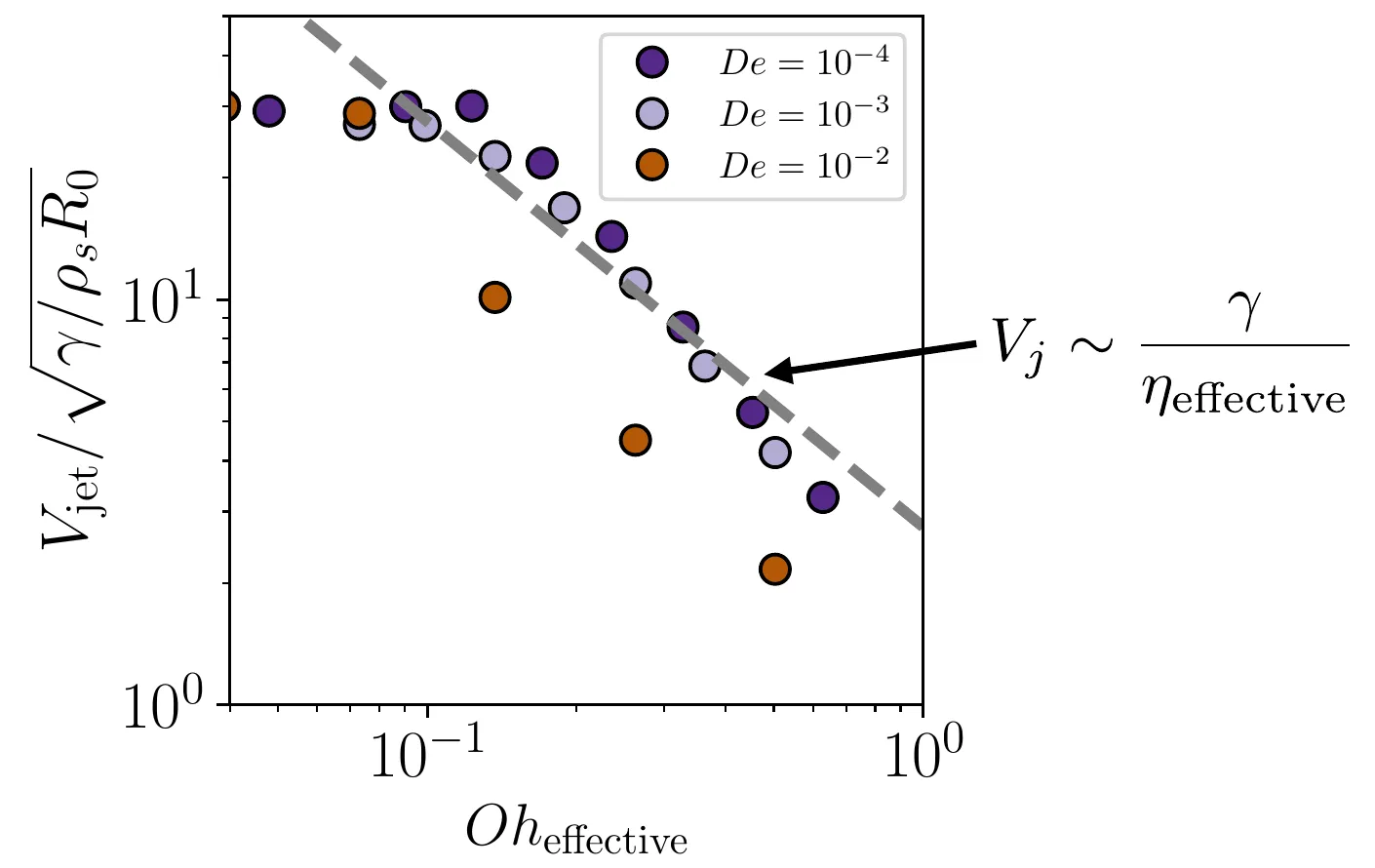 Jet speed
2.4 Intermezzo: yield stress
Toothpaste and peanut butter hold their shape until pushed hard enough: they have a yield stress
A convenient model is Saramito’s elastoviscoplastic extension of Oldroyd-B (Saramito 2007). Write the polymer stress as
- Below the yield stress (
, so ) the material is a Kelvin–Voigt solid. - Far above it (
) it is a viscoelastic Oldroyd-B liquid.
The new dimensionless group is the plastocapillary number
When elasticity can be neglected we recover the Bingham viscoplastic model (Eugene C. Bingham, 1878–1945). With
For a bursting bubble in a viscoplastic medium,
3) Drops: impact forces from Wagner to Hertz
3.1 Liquid drops and elastic beads
A water drop in space bounces off a hydrophobic paddle almost like a ball (liquid ping-pong on the ISS). So how different are a liquid drop and an elastic bead hitting a wall? Consider a sphere of radius
| Liquid drop: | Soft solid: | |
|---|---|---|
| Contact (foot) radius | ||
| Peak force |
Wagner (liquids). In the early inertial stage the displaced free surface enlarges the contact region: Wagner theory gives
Hertz (elastic solids). A sphere compressed by
3.2 Liquid drops: the first force peak
Force measurements on drops hitting a superhydrophobic surface show two peaks: one at impact and one when the drop jumps off, as a Worthington jet forms inside it (Zhang, Sanjay et al. 2022). The first peak follows inertial scaling:
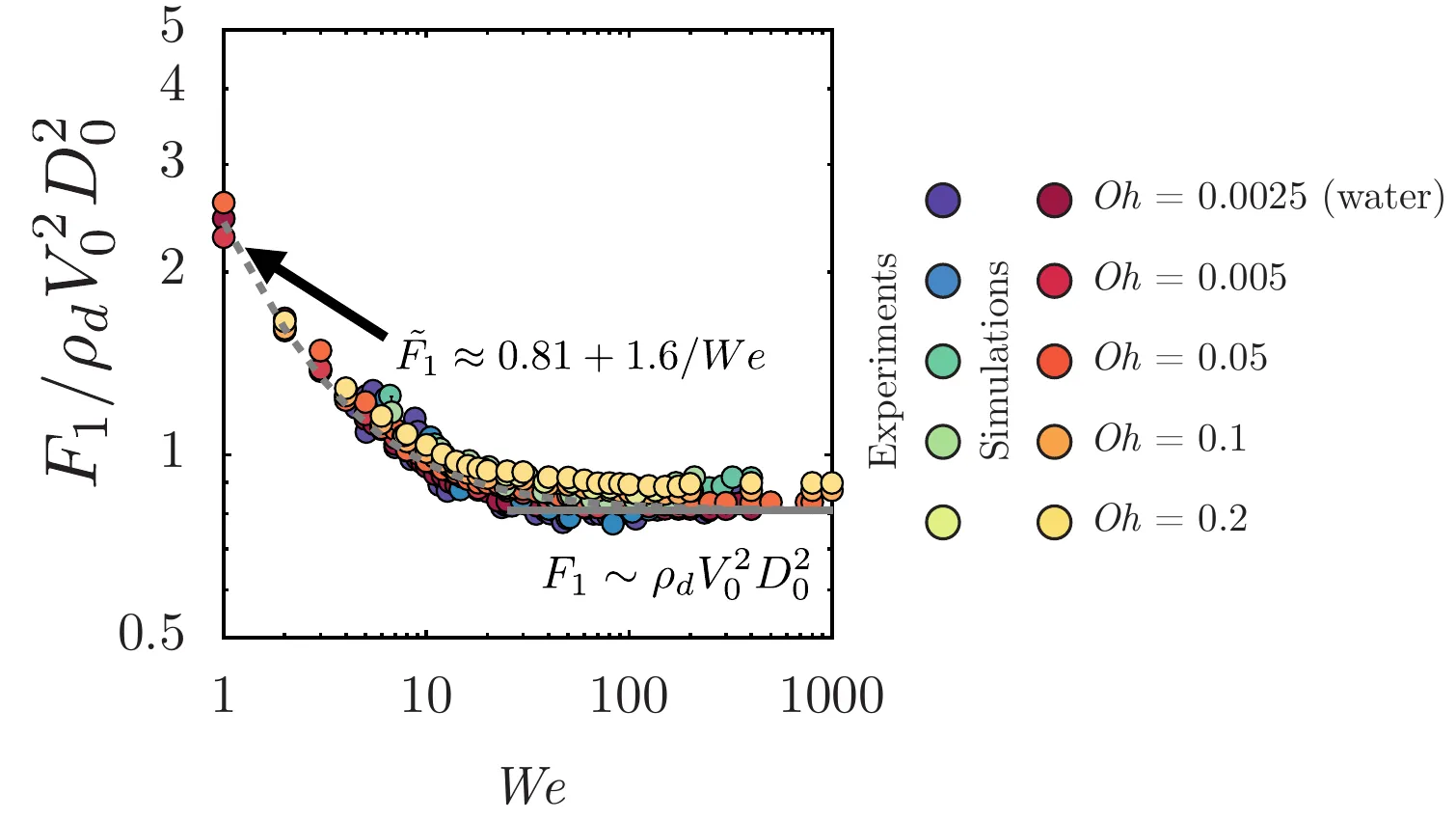 First force peak
The first peak barely depends on viscosity: it stays the same for liquids up to about a hundred times more viscous than water (Sanjay, Zhang, Lv & Lohse 2025). Only for much more viscous drops does dissipation take over. In terms of the radius, which we use from here on, the peak force is
3.3 From liquid drops to elastic beads
Now give the drop an elastic modulus
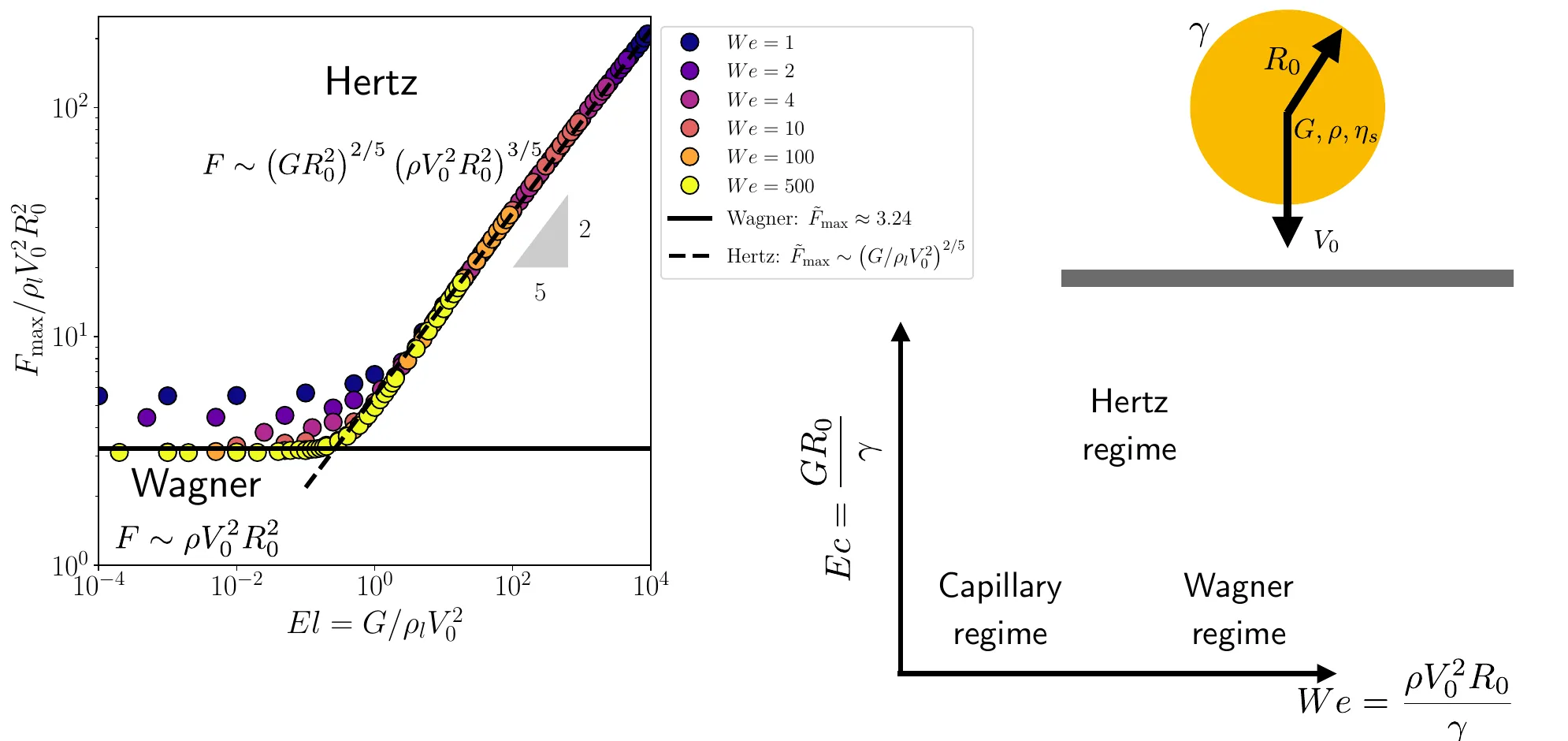 Left: peak impact force against the elasticity number
- For
the sphere behaves like a liquid drop: Wagner, , plus a capillary correction at small . - For
it behaves like an elastic bead: Hertz, . Hertz’s contact theory for an incompressible elastic sphere gives the prefactor ; the simulations give . - The transition from Wagner to Hertz is smooth, and the force curve changes shape with it: a stiff sphere gives a single, nearly symmetric force pulse, as a bouncing elastic ball does.
Sweeping the relaxation time from zero to infinity takes the same sphere continuously from a liquid drop with no memory to an elastic bead with permanent memory.
Summary
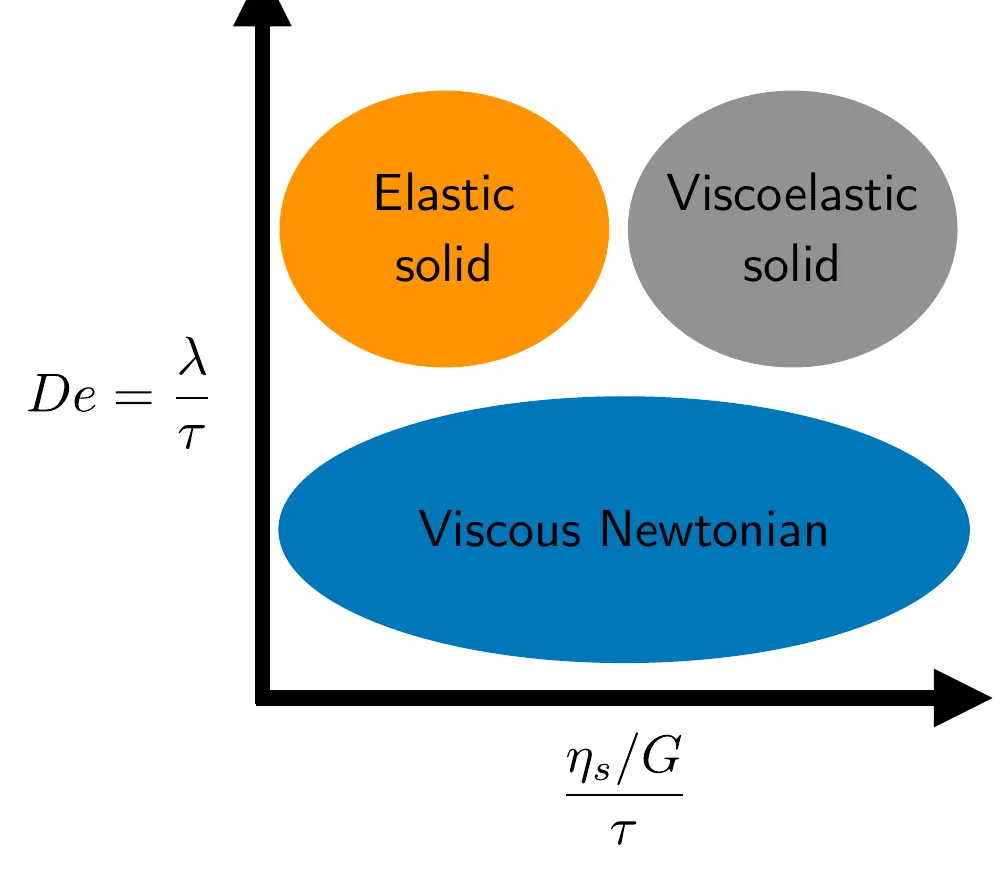 Where the three behaviours live, in terms of the Deborah number
- One model, the Oldroyd-B family, covers viscous liquids (
), elastic solids ( , ) and viscoelastic Kelvin–Voigt solids ( , of order one or larger). - Sheets: viscous dissipation in a retracting film stays finite as the viscosity vanishes. Elasticity adds a hoop stress that slows the opening; in simulations the hole stops at
, and the saturated rim thickness follows for , approaching one for large . - Bubbles: polymers can suppress the Worthington jet. For the parameter cut shown, the jet stops at roughly
at small , where the polymers act as extra viscosity, and at roughly at large , where they act elastically. A yield stress can freeze the cavity before it relaxes. - Drops: the impact force goes from Wagner,
, to Hertz, , as the elasticity number crosses one.
Self-check questions
- Show that
. Use this to explain why the jet/no-jet boundary looks like at small but like at large . - In the Kelvin–Voigt limit (
), what is for a simple shear of amount , and what is the resulting shear stress? - Derive the Hertz scaling
from an energy balance, and show that the Wagner and Hertz forces are equal when is of order one. - Why is the first force peak of a low-viscosity drop insensitive to viscosity? Compare the impact time
with the time for viscous effects to diffuse across the drop. - Estimate when elasticity can halt the opening of a hole in a sheet by comparing the elastic stress
with the capillary stress . Then derive the thin-rim hoop force of §1.2 and the rim-thickness law of §1.3.
References
- D. Tammaro, R. Pasquino, M. M. Villone, G. D’Avino, V. Ferraro, E. Di Maio, A. Langella, N. Grizzuti & P. L. Maffettone, Elasticity in bubble rupture, Langmuir 34, 5646–5654 (2018). doi:10.1021/acs.langmuir.8b00520
- V. Sanjay, U. Sen, P. Kant & D. Lohse, Taylor–Culick retractions and the influence of the surroundings, J. Fluid Mech. 948, A14 (2022). doi:10.1017/jfm.2022.671
- J. H. Snoeijer, A. Pandey, M. A. Herrada & J. Eggers, The relationship between viscoelasticity and elasticity, Proc. R. Soc. A 476, 20200419 (2020). doi:10.1098/rspa.2020.0419
- E. Ghabache, G. Liger-Belair, A. Antkowiak & T. Séon, Evaporation of droplets in a Champagne wine aerosol, Sci. Rep. 6, 25148 (2016). doi:10.1038/srep25148
- J. M. Cheny & K. Walters, Extravagant viscoelastic effects in the Worthington jet experiment, J. Non-Newtonian Fluid Mech. 67, 125–135 (1996). doi:10.1016/S0377-0257(96)01473-5
- A. K. Dixit, A. Oratis, K. Zinelis, D. Lohse & V. Sanjay, Viscoelastic Worthington jets and droplets produced by bursting bubbles, J. Fluid Mech. 1010, A2 (2025). doi:10.1017/jfm.2025.237
- X. D. Shi, M. P. Brenner & S. R. Nagel, A cascade of structure in a drop falling from a faucet, Science 265, 219–222 (1994). doi:10.1126/science.265.5169.219
- T. Driessen, R. Jeurissen, H. Wijshoff, F. Toschi & D. Lohse, Stability of viscous long liquid filaments, Phys. Fluids 25, 062109 (2013). doi:10.1063/1.4811849
- P. Saramito, A new constitutive equation for elastoviscoplastic fluid flows, J. Non-Newtonian Fluid Mech. 145, 1–14 (2007). doi:10.1016/j.jnnfm.2007.04.004
- V. Sanjay, D. Lohse & M. Jalaal, Bursting bubble in a viscoplastic medium, J. Fluid Mech. 922, A2 (2021). doi:10.1017/jfm.2021.489
- A. G. Balasubramanian, V. Sanjay, M. Jalaal, R. Vinuesa & O. Tammisola, Bursting bubble in an elastoviscoplastic medium, J. Fluid Mech. 1001, A9 (2024). doi:10.1017/jfm.2024.1073
- B. Zhang, V. Sanjay, S. Shi, Y. Zhao, C. Lv, X.-Q. Feng & D. Lohse, Impact forces of water drops falling on superhydrophobic surfaces, Phys. Rev. Lett. 129, 104501 (2022). doi:10.1103/PhysRevLett.129.104501
- V. Sanjay, B. Zhang, C. Lv & D. Lohse, The role of viscosity on drop impact forces on non-wetting surfaces, J. Fluid Mech. 1004, A6 (2025). doi:10.1017/jfm.2024.982
- V. Sanjay & D. Lohse, Unifying theory of scaling in drop impact: forces and maximum spreading diameter, Phys. Rev. Lett. 134, 104003 (2025). doi:10.1103/PhysRevLett.134.104003
- S. Jana, J. Kolinski, D. Lohse & V. Sanjay, Impacting spheres: from liquid drops to elastic beads, Soft Matter 22, 2226–2236 (2026). doi:10.1039/D5SM01078K
Previous Lecture: Lecture 5: Elastic vs Viscous vs Viscoelastic
Next Lecture: Lectures 7-8: Student Presentations
Course Home: Course Overview
Metadata
Author:: Vatsal Sanjay
Date published:: Jul 19, 2026
Date modified:: Oct 16, 2026
Back to main website