PDF version
Resolving the Dupré–Rayleigh paradox through proper energy accounting and momentum conservation. This lecture bridges Faces of Soft Matter’s introduction to the paradox with a complete resolution.
Introduction: The Unresolved Paradox
In the introduction, we encountered a puzzle: when you puncture a soap film, the hole expands with remarkable speed as the film retracts away from the puncture. Yet two seemingly correct physical approaches gave different predictions for this retraction velocity:
Question: If momentum conservation gives the right answer, why did energy conservation fail? Where did the missing energy go?
This lecture resolves the paradox. The resolution was already given by F. E. C. Culick in 1960: the film is set into motion by an inelastic process, and the mechanical energy lost in it is dissipated by viscosity.
Historical Context: A Long-Standing Mystery
Rayleigh’s Pioneering Work (1891)
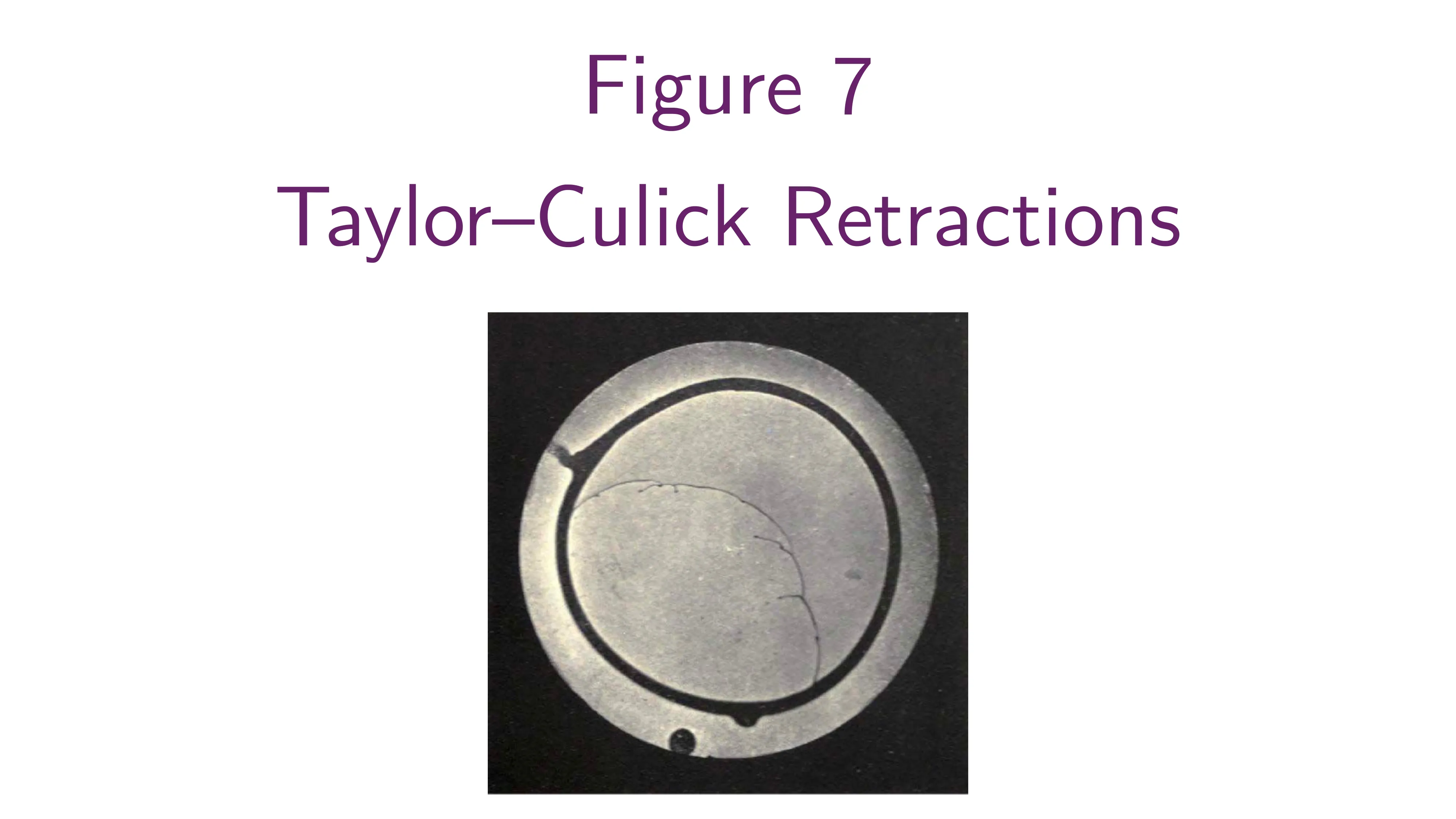
John William Strutt, 3rd Baron Rayleigh, used instantaneous photography to capture the dynamics of liquid jets and interfaces. In a remarkable 1891 paper, he observed breaking jets and reported Dupré’s energy-balance argument for the speed of film retraction:
Rate of surface energy decrease = Rate of kinetic energy increase
Mathematically:
This yielded:
A Curious Anomaly
Despite its elegant derivation, this is a naïve lossless-energy estimate: it is a factor of
The Three Perspectives: Energy, Momentum, and Dissipation
1. The Naïve Lossless-Energy Estimate (Dupré & Rayleigh, 1891)
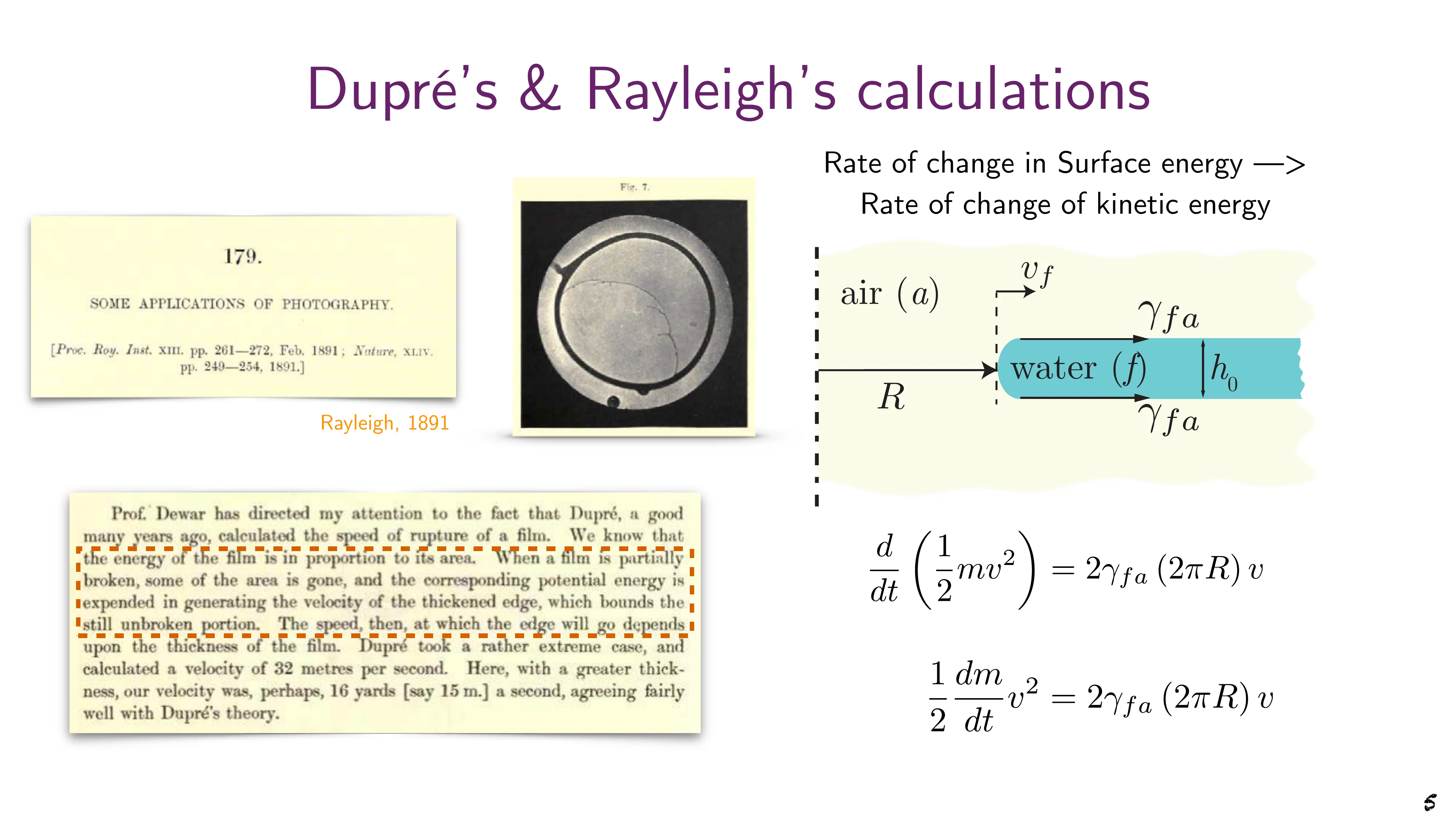
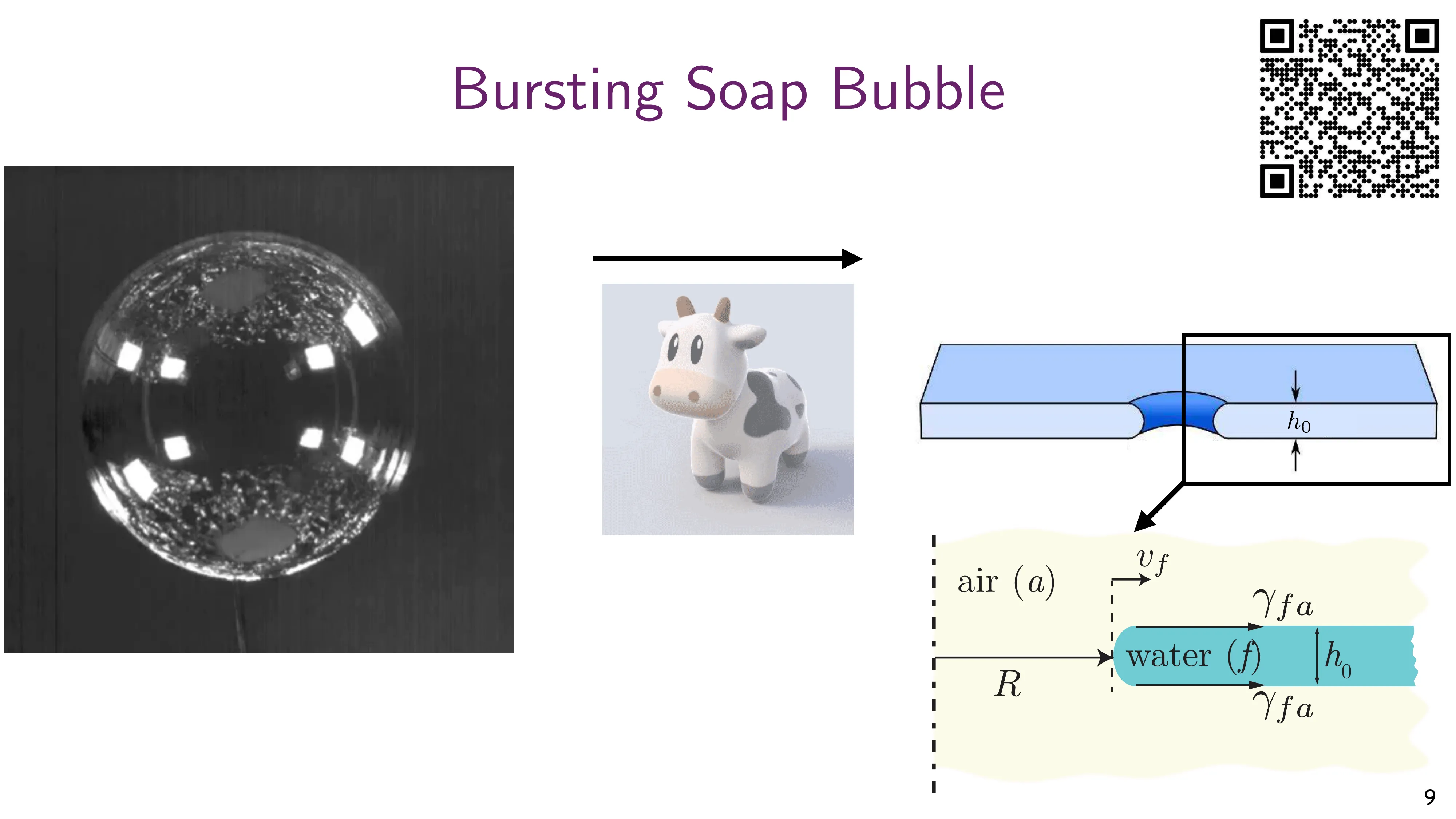
The energy balance assumes that all surface energy released goes into kinetic energy of the rim, i.e. that no mechanical energy is lost. We keep this estimate deliberately: its failure is the point of the paradox.
Setup: a circular hole of radius
Surface energy released: two faces of area
Mass collected in the rim:
At constant speed the rim’s kinetic energy grows only because its mass grows:
If all the released surface energy became kinetic energy of the rim:
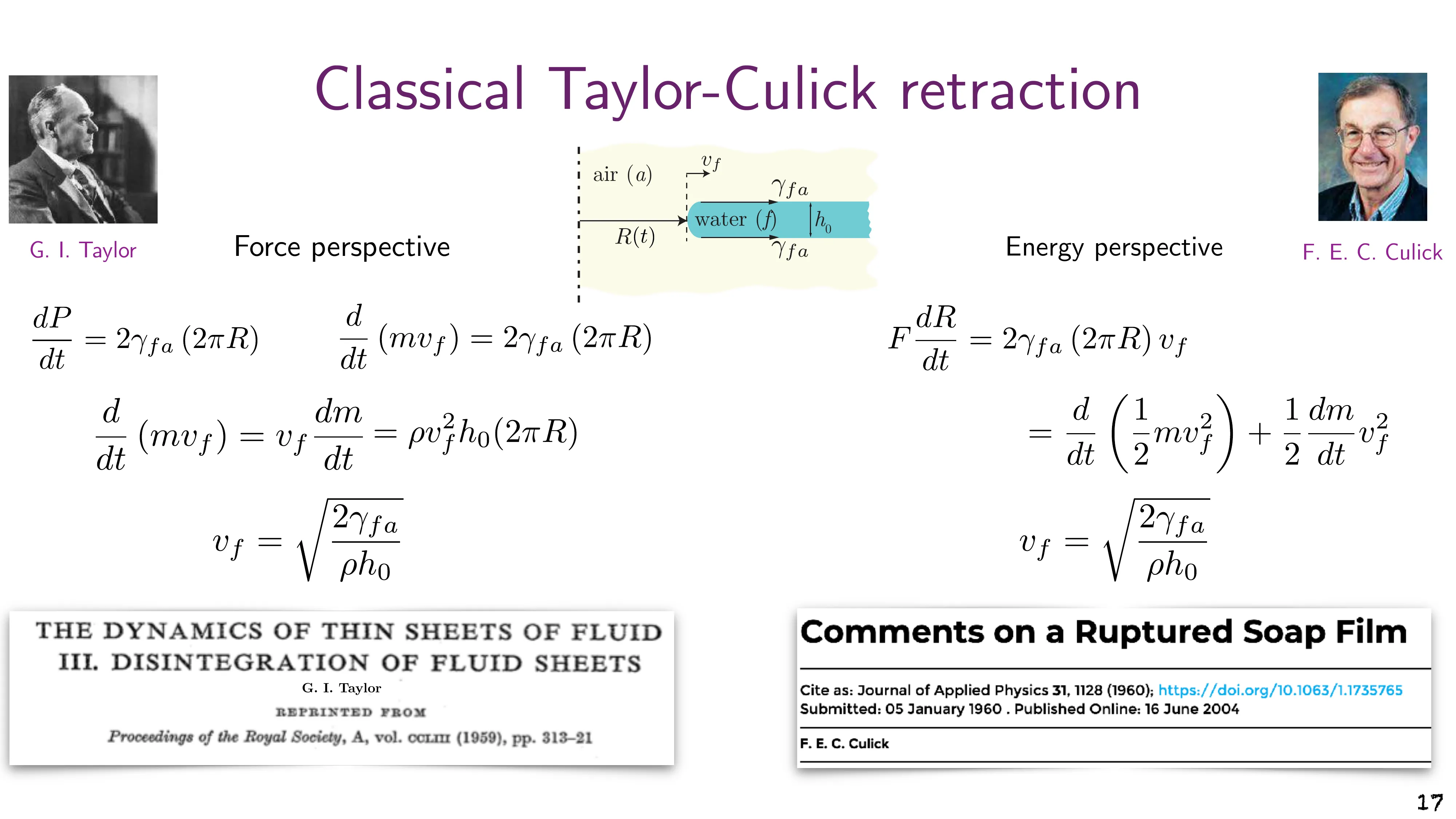
2. The Momentum Perspective (G. I. Taylor, 1959)
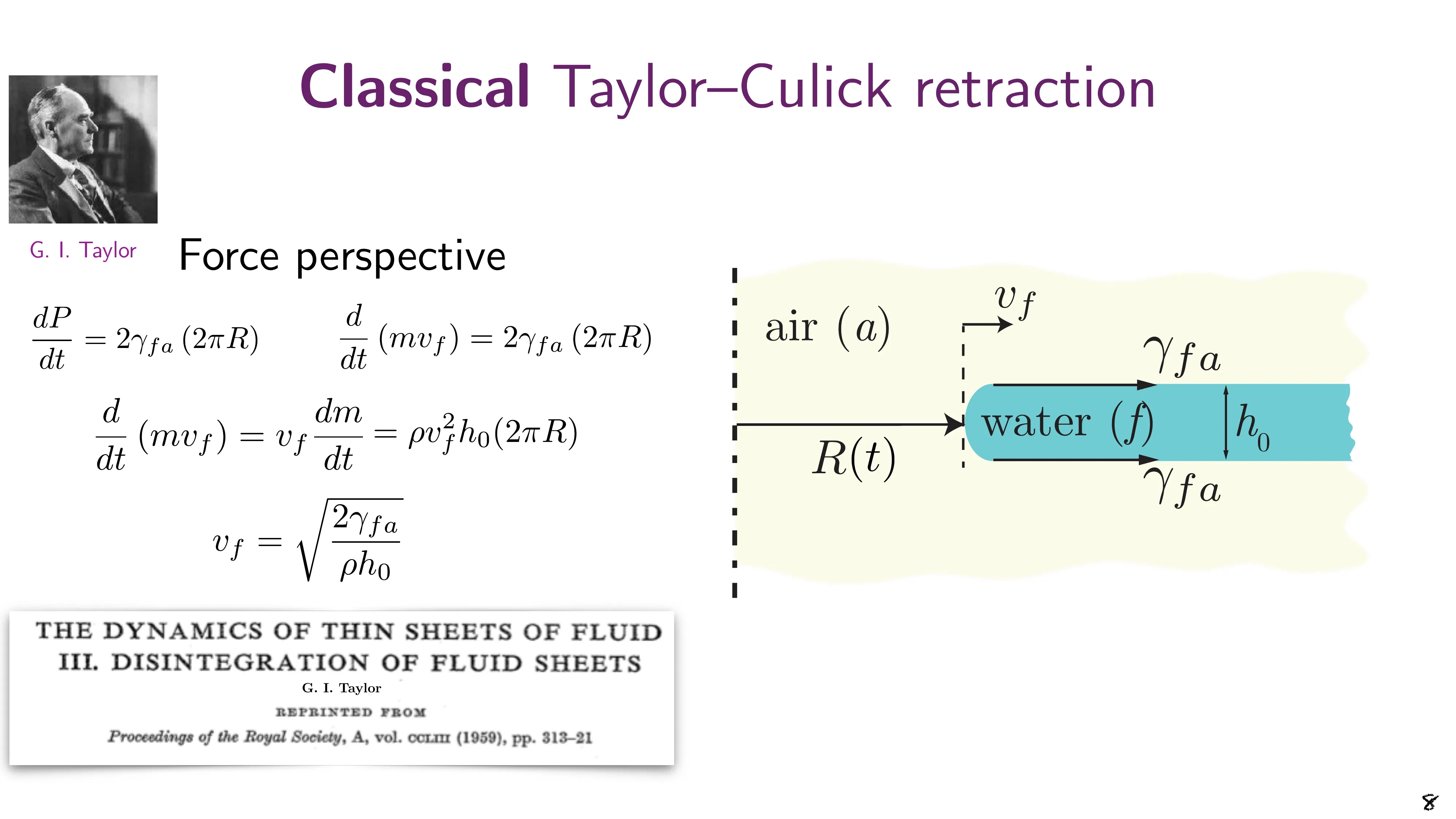
G. I. Taylor (1886–1975), one of the greatest fluid mechanicists, approached the problem differently: he used momentum conservation instead of energy.
Newton’s second law: Force = Rate of momentum change
Forces on the film:
- Surface tension acts on the perimeter of the film at both interfaces
- Total force:
(pointing radially outwards, driving the expansion of the hole)
Rate of momentum change:
The rim is pulled radially outwards by surface tension. The material in the rim has momentum
For initially stationary film material captured by the rim:
This gives:
Assuming steady-state (
Remarkable fact: Taylor’s prediction agrees with experiments! This immediately suggested that the energy approach was wrong—but why?
3. The Missing Link: Inelastic Capture (Culick, 1960)
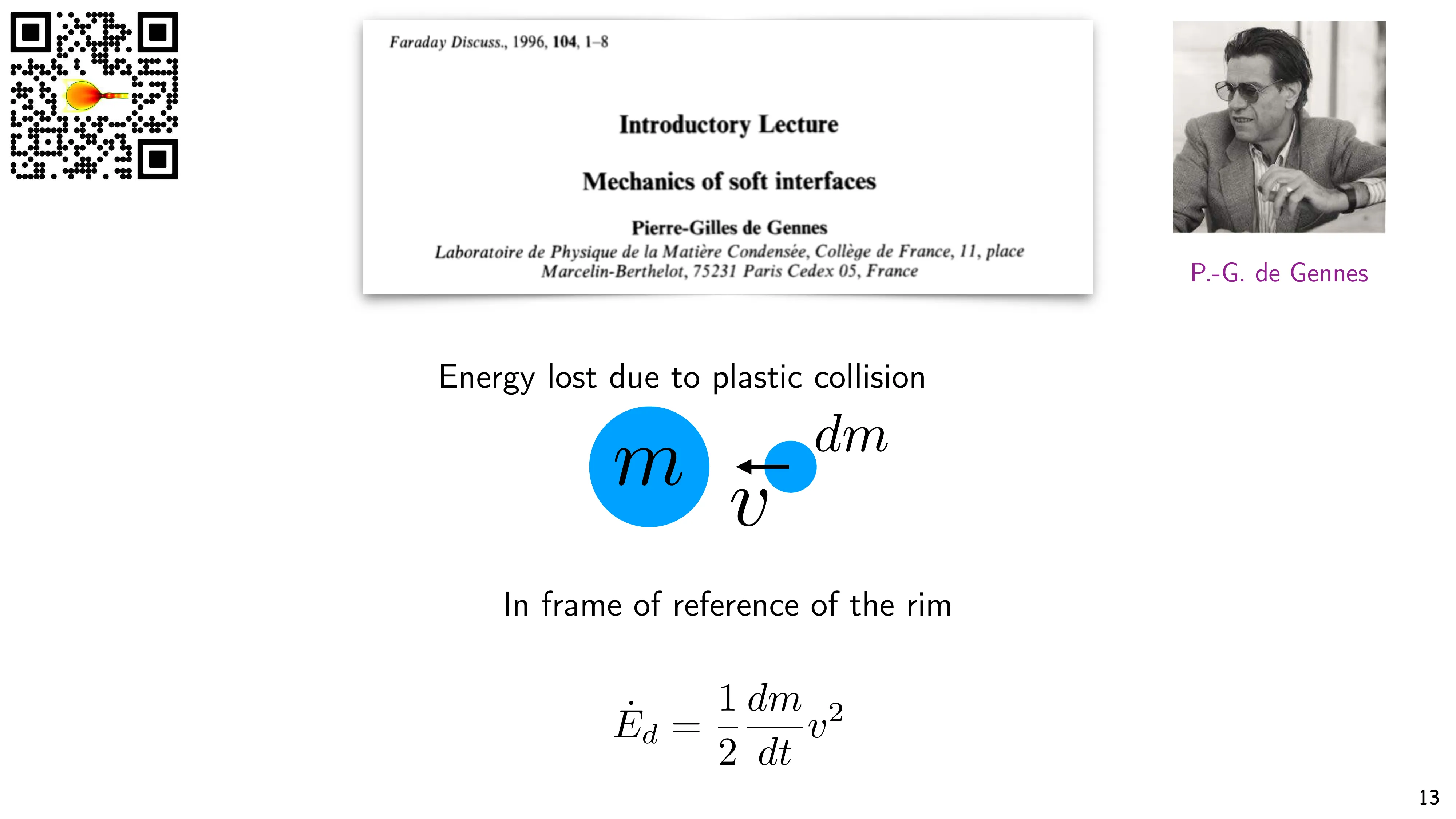
F. E. C. Culick identified the missing piece in 1960, in a short comment on measurements of bursting soap films: the undisturbed film is accelerated inelastically up to the speed of the edge, and the mechanical energy lost in this process is dissipated by viscosity. Pierre-Gilles de Gennes (Nobel Prize 1991) later revisited bursting films in his 1996 Faraday Discussions introductory lecture on the mechanics of soft interfaces.
The Key Insight
The film material does not smoothly flow into the retracting rim. Instead, it collides inelastically with the rim, dissipating energy. This is a plastic collision, not an elastic process.
Energy Budget with Dissipation
When the soap film retracts, the material at the film edge joins the rim. This material transition is inelastic:
- Before collision: the film ahead of the rim is at rest
- After collision: it moves with the rim at
- Energy dissipated: each mass element is accelerated from
to in a plastic (perfectly inelastic) collision
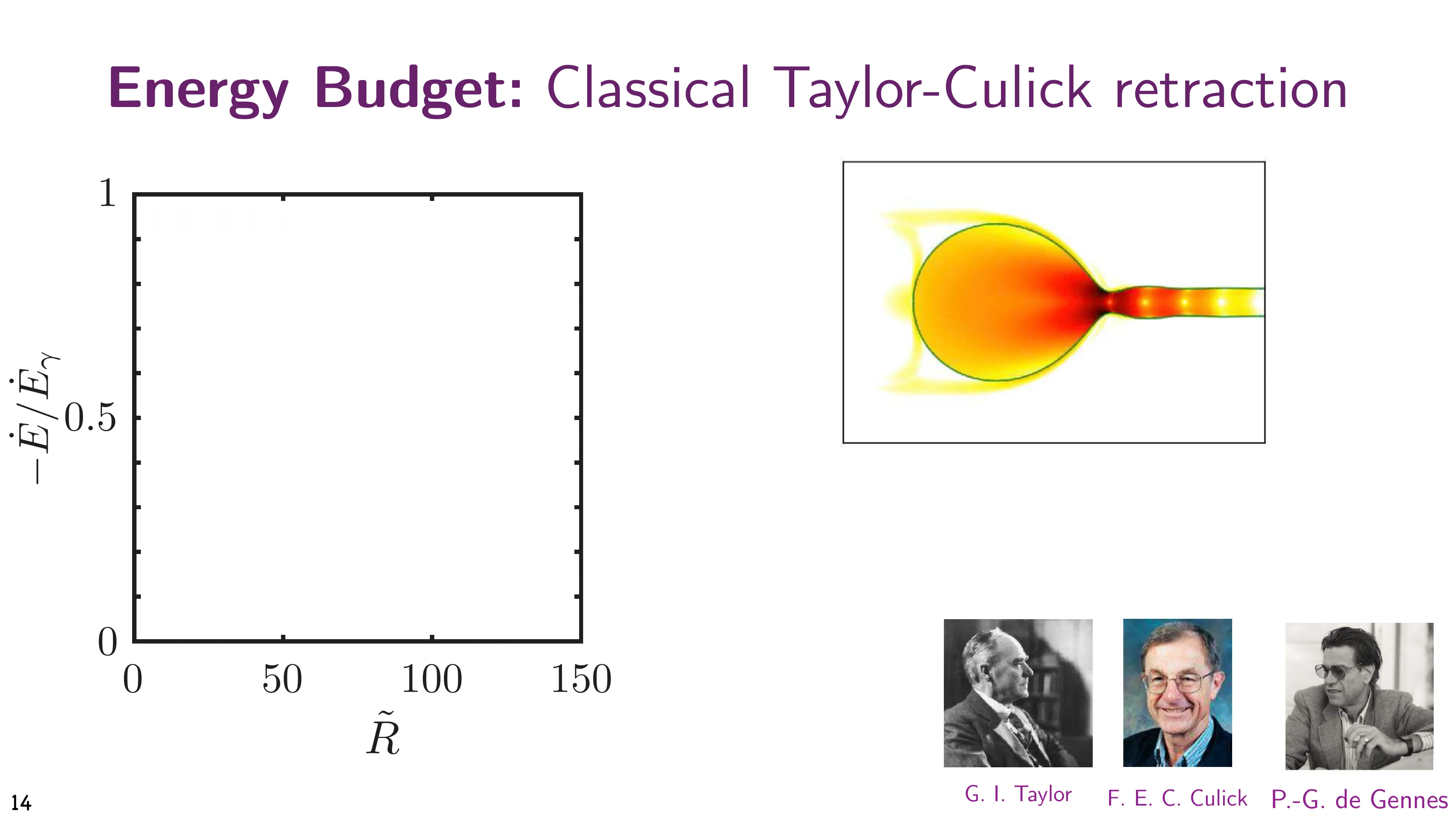
The energy dissipation rate from the inelastic collision:
In the rim’s frame the film arrives at
Complete Energy Balance
Let’s now account for all energy flows:
Energy released by surface tension:
Energy dissipated (inelastic collision):
Energy conservation (with dissipation):
Resolving the Apparent Contradiction
The resolution lies in momentum conservation vs. energy conservation:
Why Momentum Conservation Works
Momentum balance directly applies regardless of dissipation:
This is valid whether the process is elastic or inelastic. The surface tension force acts on the film perimeter, and momentum is conserved:
Why the Original Energy Balance Failed
The error in the Dupré–Rayleigh approach was assuming that only kinetic energy matters.
But this neglected dissipation as the film material is “compressed” into the rim. The correct energy balance is:
The “missing” energy,
The Ohnesorge Number and Flow Regimes
The dynamics of film retraction depend on the balance between surface tension (driving the flow) and viscosity (resisting it).
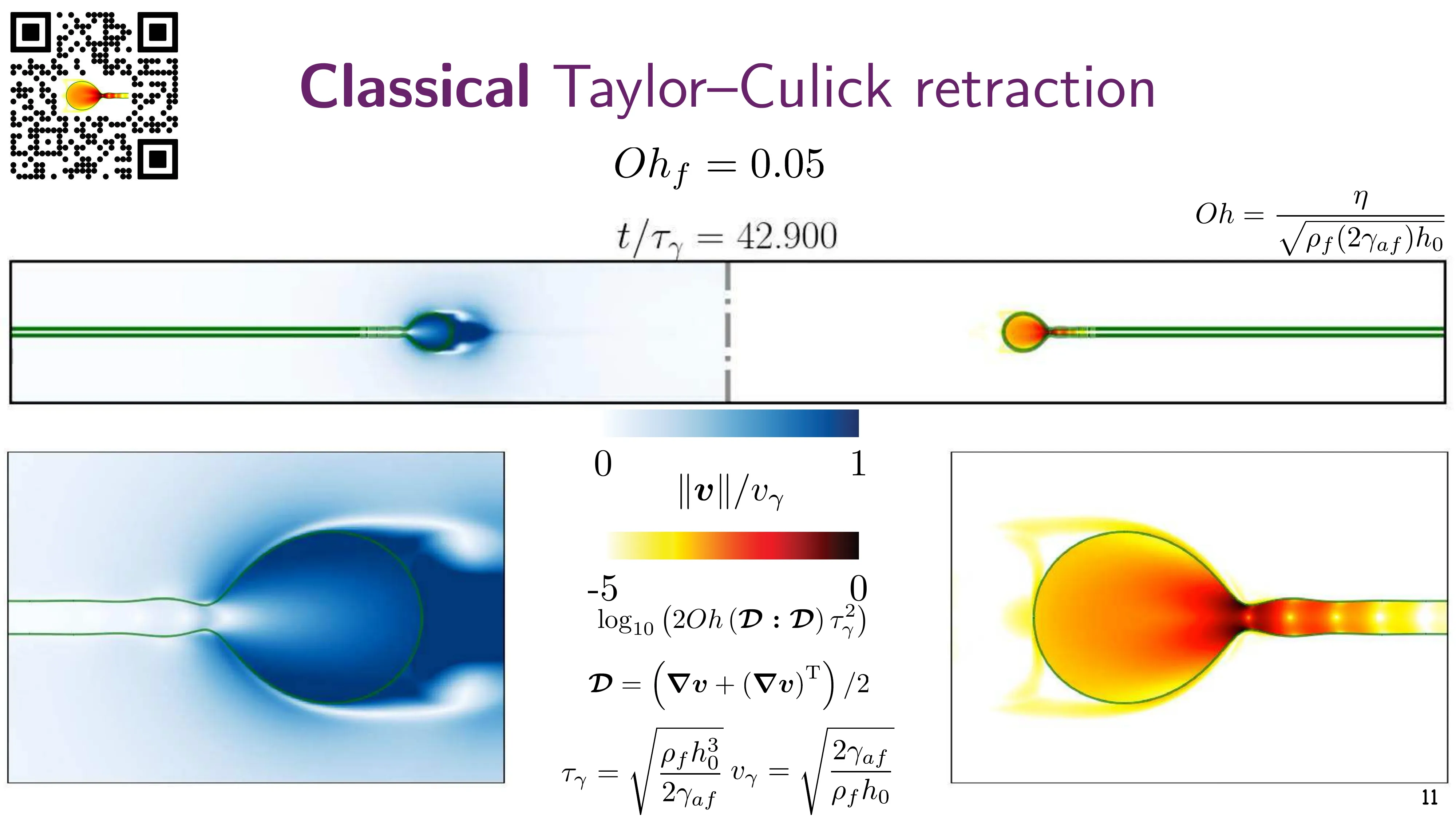
Ohnesorge number:
where
- Low
regime: a compact rim forms and reaches the Taylor–Culick speed soon after rupture - High
regime: viscous stresses spread the retraction over a long, gradually thickening region of the film instead of a compact rim, and the edge takes longer to reach its final speed
In both regimes, an isolated flat film with negligible resistance from the surrounding air eventually retracts at the Taylor–Culick speed
Experimental Validation and Simulations
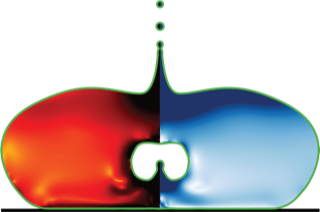
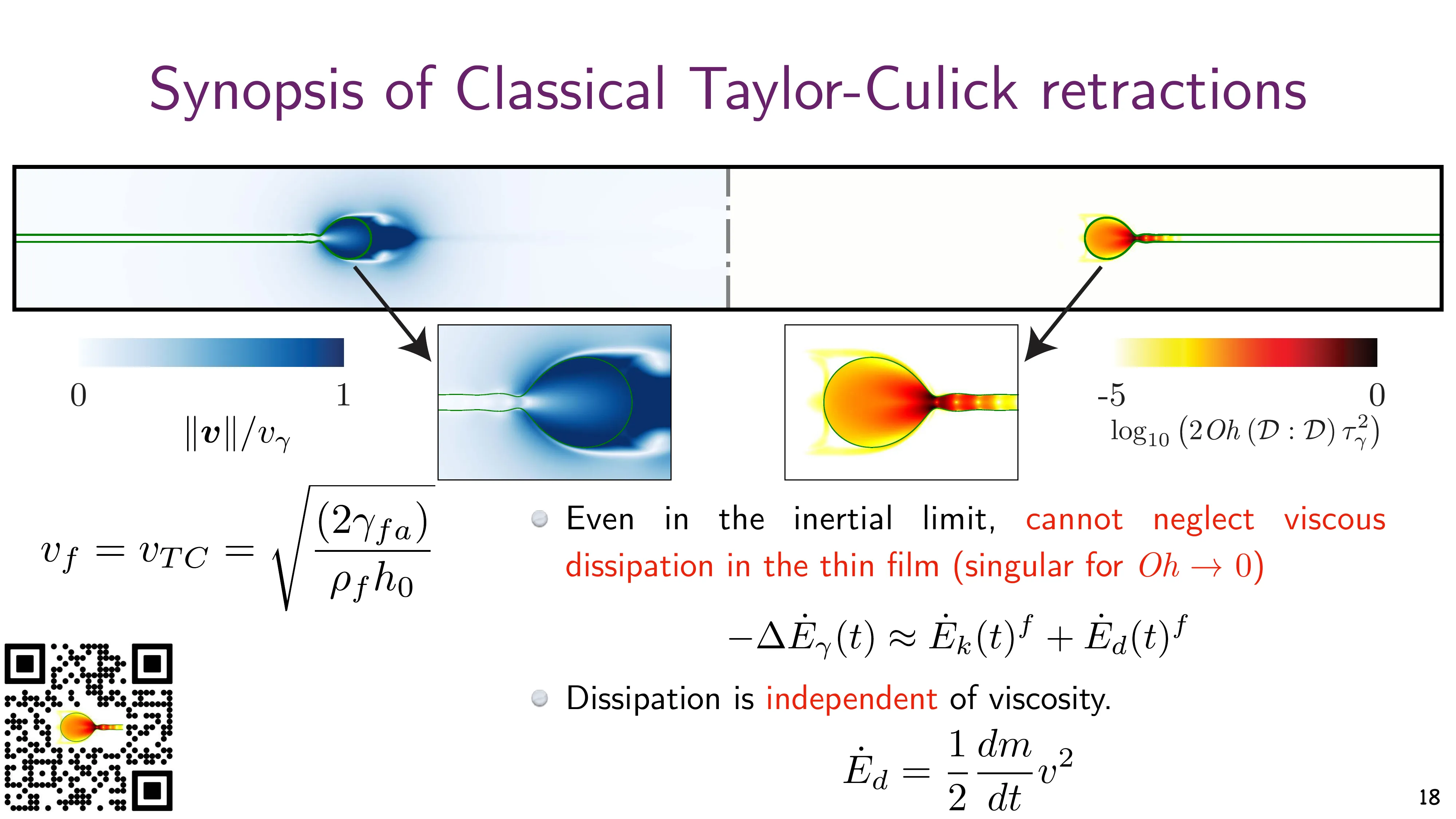
Modern high-speed imaging and numerical simulations have beautifully confirmed the resolution:
Key observations:
- Bursting films retract at speeds very close to Taylor’s prediction
- Velocity field shows strong acceleration from rest to
- Dissipation concentrates near the retracting edge (the rim region)
- At high Oh, viscous stresses spread the deformation along the film instead of concentrating it in a compact rim (a viscous effect; viscoelasticity requires an elastic, for example polymeric, liquid)
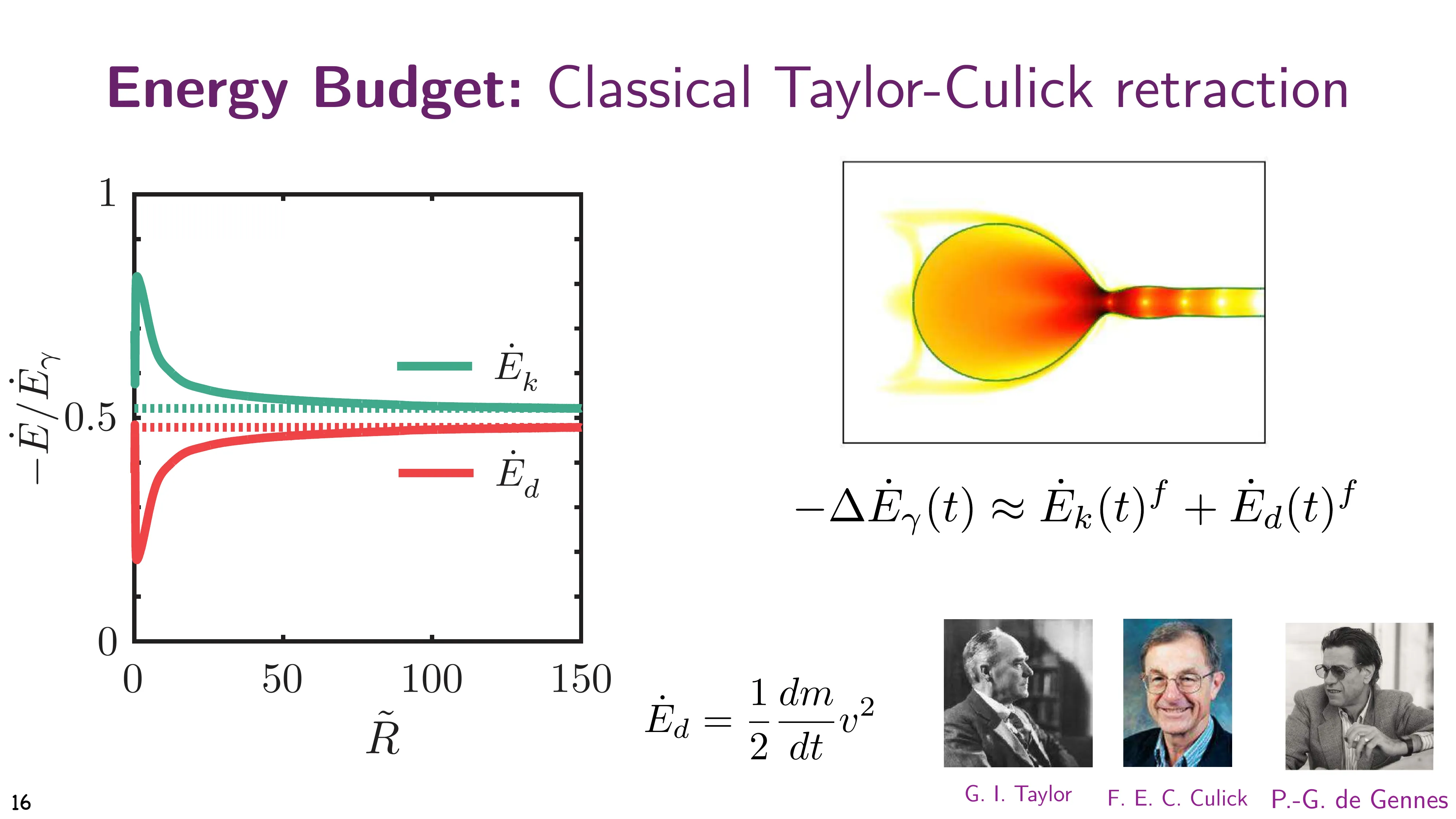
Simulations reveal that the velocity profile is not uniform—there’s acceleration from the edge into the rim, and stress concentrations that lead to localized dissipation.
Historical Timeline and Key References
| Year | Contributor | Contribution |
|---|---|---|
| 1891 | Rayleigh | Photographs bursting films; reports Dupré’s energy-balance estimate |
| 1959 | G. I. Taylor | Momentum-balance approach; predicts |
| 1960 | F. E. C. Culick | Same speed for bursting soap films; identifies the inelastic acceleration of the film and the resulting loss of mechanical energy to viscous dissipation |
| 1996 | P.-G. de Gennes | Revisits bursting films in a lecture on the mechanics of soft interfaces |
| 2009 | N. Savva & J. W. M. Bush | Viscous films reach the Taylor–Culick speed after a viscosity-dependent transient |
On the importance of this problem
The Taylor–Culick paradox exemplifies a deep principle: momentum conservation is always valid, but energy conservation requires accounting for dissipation mechanisms. This lesson transfers to many soft matter phenomena where interfaces dominate.
Key Takeaways
-
Momentum conservation is robust. The Taylor–Culick speed
follows directly from force balance and does not depend on details of energy dissipation. -
Energy dissipation is not negligible. The naive energy-balance approach fails because it ignores the inelastic collision process—energy is not smoothly converted to kinetic energy alone.
-
Multiple equilibrium approaches. For the same physical process, different conservation laws give different perspectives. Momentum is fundamental; energy requires accounting for all sinks.
-
Viscosity sets the transient, not the final speed. At low Oh a compact rim forms quickly; at high Oh viscous stresses spread the retraction along the film and the edge takes longer to accelerate. An isolated film eventually retracts at the Taylor–Culick speed in both cases. Viscosity is not viscoelasticity: elastic films are a separate problem (see the notes on sheets, bubbles and drops).
-
Paradoxes resolve through careful accounting. Many apparent contradictions in physics arise from incomplete accounting of energy or momentum sinks/sources. Always ask: “Where did the energy/momentum go?”
Further Reading
Primary Literature
- G. I. Taylor, Proc. R. Soc. A, 253, 313–321 (1959) — Classic momentum-balance derivation
- F. E. C. Culick, Comments on a ruptured soap film, J. Appl. Phys., 31, 1128–1129 (1960) — Momentum balance, inelastic acceleration of the film and the lost mechanical energy
- P.-G. de Gennes, Introductory lecture: Mechanics of soft interfaces, Faraday Discuss., 104, 1–8 (1996) — Includes the bursting of liquid films
- N. Savva & J. W. M. Bush, Viscous sheet retraction, J. Fluid Mech., 626, 211–240 (2009) — Viscous films reach the Taylor–Culick speed after a viscosity-dependent transient
Supplementary Materials
- Dupré–Rayleigh paradox (PDF) — Comprehensive reference document on the paradox resolution
Connection to viscosity and conservation laws
This resolution of the Taylor–Culick paradox illustrates the power of conservation laws in fluid mechanics. In the notes on viscosity and conservation laws, we develop a systematic framework for:
- Conservation of momentum → Euler and Navier–Stokes equations
- Conservation of energy → Thermodynamics and dissipation
- Continuum mechanics → Coarse-grained descriptions of soft matter
Understanding why momentum conservation works (even when energy accounting is subtle) is central to soft matter hydrodynamics.
Homework (Self-Assessed)
Reflection Questions
Q1. In the naïve lossless-energy estimate, why does neglecting dissipation lead to a speed that’s
times faster than the Taylor–Culick speed? Q2. Explain in words why momentum conservation “just works” even though energy dissipation is important. Why is momentum balance insensitive to the details of how energy is dissipated?
Q3. Consider a highly viscous film (large
, large Ohnesorge number). How does viscosity change the early retraction, and does it change the speed that an isolated flat film eventually reaches? Explain your reasoning using the momentum balance and scaling arguments. Q4. Design a thought experiment or simple calculation to estimate the fraction of released surface energy that goes into:
- (a) Kinetic energy of the rim
- (b) Dissipation (heating, deformation)
Metadata
Author:: Vatsal Sanjay
Back to main website