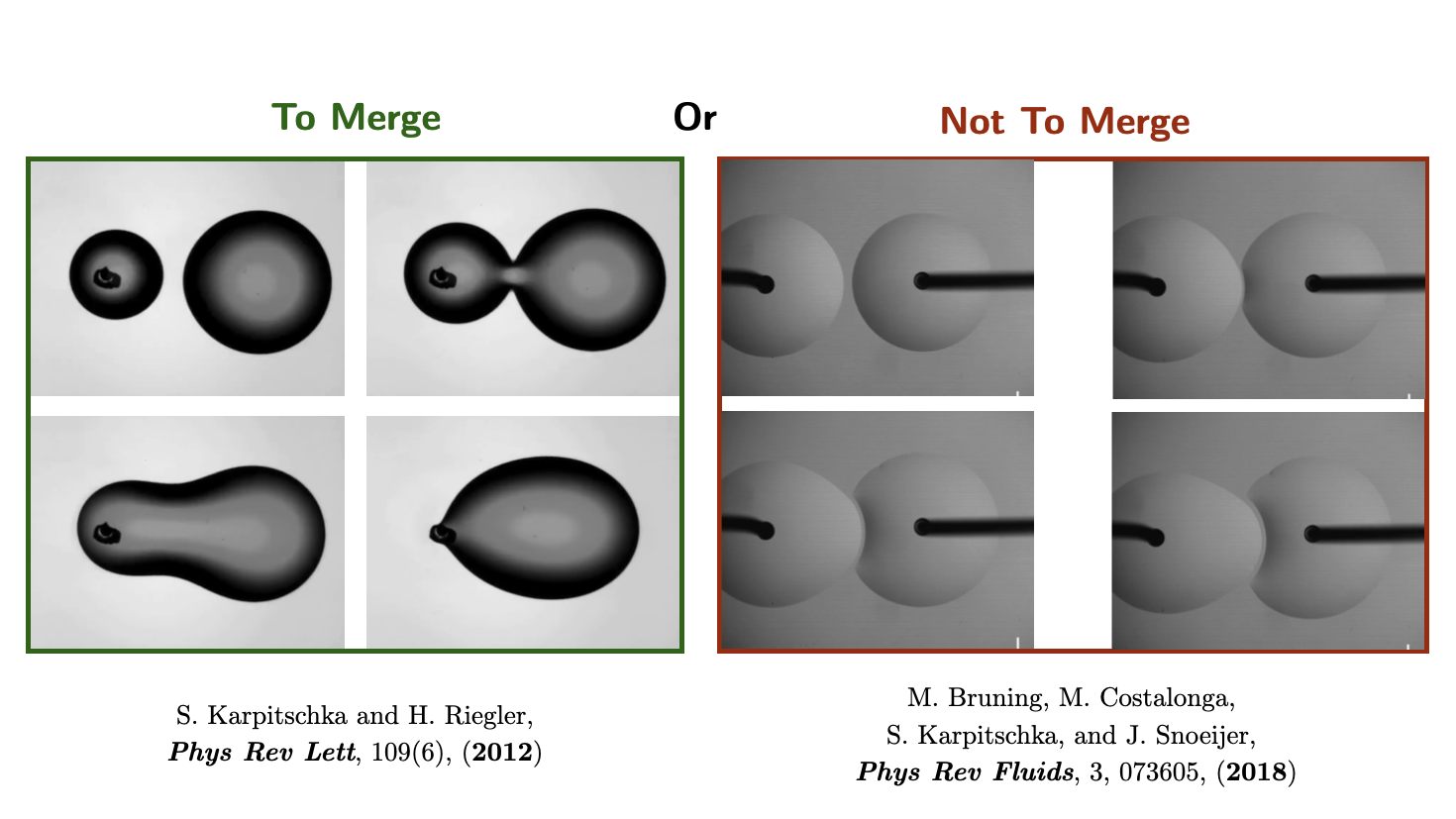
# To merge or not to merge?
> [!significance] Authors
> Jnandeep Talukdar, Duarte Rocha, Christian Diddens, Jacco Snoeijer, Detlef Lohse, and [Vatsal Sanjay*](https://comphy-lab.org)
![[Seminar-Coalescence-with-Surfactants-1767795012556.png|To merge or not to merge]]
Coalescence of two sessile drops is initiated by a topological transition at first
contact: a microscopic liquid bridge nucleates and grows from a vanishing initial length
scale, launching the canonical coalescence singularity. For clean interfaces this bridge
expansion is symmetric, but the outcome can flip when one drop carries surfactant and the
other is clean: rather than merging, one drop can push the other aside. This matters
because coalescence outcomes directly control pattern fidelity in inkjet printing, mixing
efficiency in microfluidic handling, and emulsion stability, yet the earliest
surfactant-mediated dynamics at first contact remain poorly characterised.
This talk shows how insoluble surfactants modify this earliest stage in an
asymmetric configuration where one sessile drop is initially coated (concentration
$\Gamma_0$) and the other is clean. Using a long-wave lubrication model coupled to
surfactant transport, together with asymptotic analysis and high-resolution simulations,
we map regimes in surfactant strength $\beta$, surface Peclet number $Pe$ (interfacial
advection relative to surface diffusion), and contact angle $\theta$. In the
rapid-diffusion limit ($Pe \to 0$), surfactant quickly homogenises near the neck, so the
bridge height follows the clean-drop similarity with renormalised capillary driving, $h_0
\simeq 0.272(1-\beta\Gamma_0/2)\theta^4 t$, while transient Marangoni stresses break
symmetry and drive a drift $x_0 \propto t^{3/2}$ with a diffusion-controlled maximum
excursion $x_f \sim \beta Pe$. In the slow-diffusion limit ($Pe \to \infty$), surfactant
remains sharply segregated and sharp fronts develop; the dynamics are organised by a
critical strength $\beta_c \approx 0.15$: above $\beta_c$, Marangoni stresses suppress
vertical bridge growth and sustain a translating, weakly coalescent state, whereas below
$\beta_c$ drift arrests via vorticity generation. In the purely advective limit, the
surfactant field develops Burgers-type kinematic shocks. Overall, these results provide a
regime map for surfactant-mediated sessile-drop coalescence at first contact.
[[Seminar-Coalescence-with-Surfactants.pdf|this page in .pdf]]