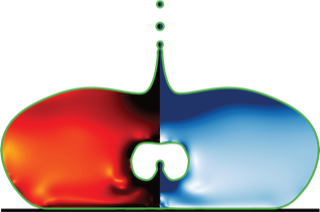
Why
A smooth stress tensor has a unique value at the axis, even though the radial and azimuthal basis vectors depend on the direction of approach. Rotational symmetry therefore makes the radial and hoop stresses equal at
We assume a smooth, symmetric stress tensor whose Cartesian components admit a Taylor expansion near the axis. The field is axisymmetric: rotating the position about
1. Establish parity on a line through the axis
Take the line
Here, even and odd parity refer to smooth continuation along a signed transverse coordinate through the axis; the cylindrical radius itself is nonnegative. Continuity then relates the radial-velocity coefficients to axial derivatives, giving
2. Use rotational symmetry at the axis
At
or, in cylindrical components,
The mixed transverse-axial components also vanish at the axis because no nonzero transverse vector is invariant under all rotations.
3. Determine the first allowed difference
On the positive
Their Taylor series have equal constant terms and no linear terms. We can write
Subtracting gives
The difference may vanish faster, but it cannot start at
4. Check the Cartesian representation
For the meridionally reflection-symmetric stress used in the slender-jet model,
where
Substituting the quadratic difference gives
which is smooth at the origin. The directional factor
The reflection assumption removes azimuthal shear away from the axis. Axisymmetry and a swirl-free velocity alone do not impose that condition on an arbitrary prescribed polymer stress. The regularity of the remaining polymer components, and their contribution to momentum, are developed in the polymer-stress note.